
Bond yield is one of the most important concepts to understand when investing in fixed-income securities. It helps investors evaluate how much income a bond may generate relative to its price and how its potential return compares with other investment opportunities.
However, bond yield is not the same as the interest rate printed on a bond. A bond’s market price, maturity date, credit quality, and prevailing interest rates can all affect the return an investor may earn.
Whether you are exploring government bonds, corporate bonds, or other fixed-income investments, understanding bond yield can help you make more informed financial decisions.
In this guide, you will learn what bond yield means, how it works, the difference between coupon rate and yield, how to calculate current yield, what yield to maturity means, and which risks investors should consider before buying bonds.
What Is Bond Yield?
Bond yield is a measure of the income or return an investor receives from a bond relative to its price or investment cost. The exact meaning depends on the yield measure being used.
When governments and companies need to raise money, they may issue bonds. Investors who purchase these bonds are lending money to the issuer. In return, the issuer generally promises to pay interest and repay the principal according to the bond’s terms.
For example, suppose a company issues a bond with a face value of $1,000 and an annual coupon payment of $60. The coupon rate is 6% because the annual interest payment equals 6% of the bond’s face value.
However, imagine another investor purchases that same bond in the market for $900. The bond still pays $60 annually, but the investor pays less to receive those payments. The bond’s current yield is therefore higher than its original coupon rate.
This example illustrates why bond yield depends not only on the interest payments but also on the price an investor pays.
For an official introduction to bonds and their characteristics, see the U.S. Securities and Exchange Commission’s Investor.gov bond guide.
How Does Bond Yield Work?
Bond yield helps investors understand the income a bond generates relative to its current market price or the return they may receive if they hold it until maturity.
A bond typically has several important characteristics:
- Face value: The principal amount specified in the bond’s terms.
- Coupon rate: The stated annual interest rate applied to the face value.
- Coupon payment: The interest amount paid to the bondholder.
- Market price: The price at which the bond currently trades.
- Maturity date: The date on which the bond is due to be repaid according to its terms.
- Yield: A return measure calculated using the bond’s income, price, and, depending on the measure, other cash flows.
These terms are related but are not interchangeable.
For example, a bond with a $1,000 face value and a 5% coupon rate generally pays $50 in annual interest. If its market price changes, the annual coupon payment on a fixed-rate bond usually remains the same, but its current yield changes.
When the bond trades at a lower price, the fixed coupon payment represents a larger percentage of the purchase price. When it trades at a higher price, the same payment represents a smaller percentage.
This relationship is a central principle of bond investing.
What Is the Difference Between Coupon Rate and Bond Yield?
The coupon rate is the stated annual interest rate calculated using a bond’s face value. Bond yield measures the return relative to a price or investment amount and can incorporate different factors depending on the calculation.
Consider a bond with a face value of $1,000 and an annual coupon rate of 5%.
Its annual coupon payment is:
$1,000 × 5% = $50
The bond’s coupon rate remains 5% even if its market price changes. Its current yield, however, changes with its price.
| Bond market price | Annual coupon payment | Current yield |
|---|---|---|
| $1,000 | $50 | 5.00% |
| $900 | $50 | 5.56% |
| $1,100 | $50 | 4.55% |
These figures are illustrative and exclude transaction costs and taxes.
The key distinction is that the coupon rate is based on face value, while current yield is based on market price.
A bond’s yield to maturity is different again because it considers the bond’s purchase price, future coupon payments, repayment at maturity, and the time remaining until maturity.
How to Calculate Bond Yield

There are several ways to measure bond yield. Two common measures are current yield and yield to maturity.
1. Current Yield Formula
Current yield measures a bond’s annual coupon income as a percentage of its current market price.
The formula is:
Current Yield = (Annual Coupon Payment ÷ Current Market Price) × 100
For example, assume you purchase a bond with these characteristics:
- Face value: $1,000
- Annual coupon rate: 6%
- Annual coupon payment: $60
- Current market price: $950
First, calculate the annual coupon payment:
$1,000 × 6% = $60
Next, calculate the current yield:
($60 ÷ $950) × 100 = 6.32%
The current yield is approximately 6.32%.
This means the annual coupon payment represents about 6.32% of the bond’s current market price.
However, current yield does not account for any gain or loss that may occur when the bond matures or is sold. It also excludes transaction costs and taxes.
2. Yield to Maturity (YTM)
Yield to maturity, commonly abbreviated as YTM, estimates the annualized return an investor would receive by purchasing a bond at its current price and holding it until maturity, assuming the issuer makes the required payments and the relevant cash flows occur as expected.
Unlike current yield, YTM considers more than coupon income. It incorporates the purchase price, coupon payments, repayment of face value, and time remaining until maturity.
For example, suppose a bond has a face value of $1,000 but trades for $900. If the bond pays fixed interest and repays $1,000 at maturity, an investor who purchases it for $900 may receive both coupon income and a gain from the difference between the purchase price and the maturity repayment.
The actual yield to maturity depends on the coupon schedule, purchase price, maturity date, and other contractual details. It is generally calculated using a financial calculator or bond-pricing software rather than the simple current-yield formula.
YTM is useful when comparing bonds with different prices and coupon rates, but it is not a guaranteed realized return. Its assumptions may not match the investor’s actual experience, especially if the bond defaults or is sold before maturity.
For further details, the SEC’s guide to corporate bonds explains coupon payments, bond prices, and yield to maturity.
Why Do Bond Prices and Yields Move in Opposite Directions?
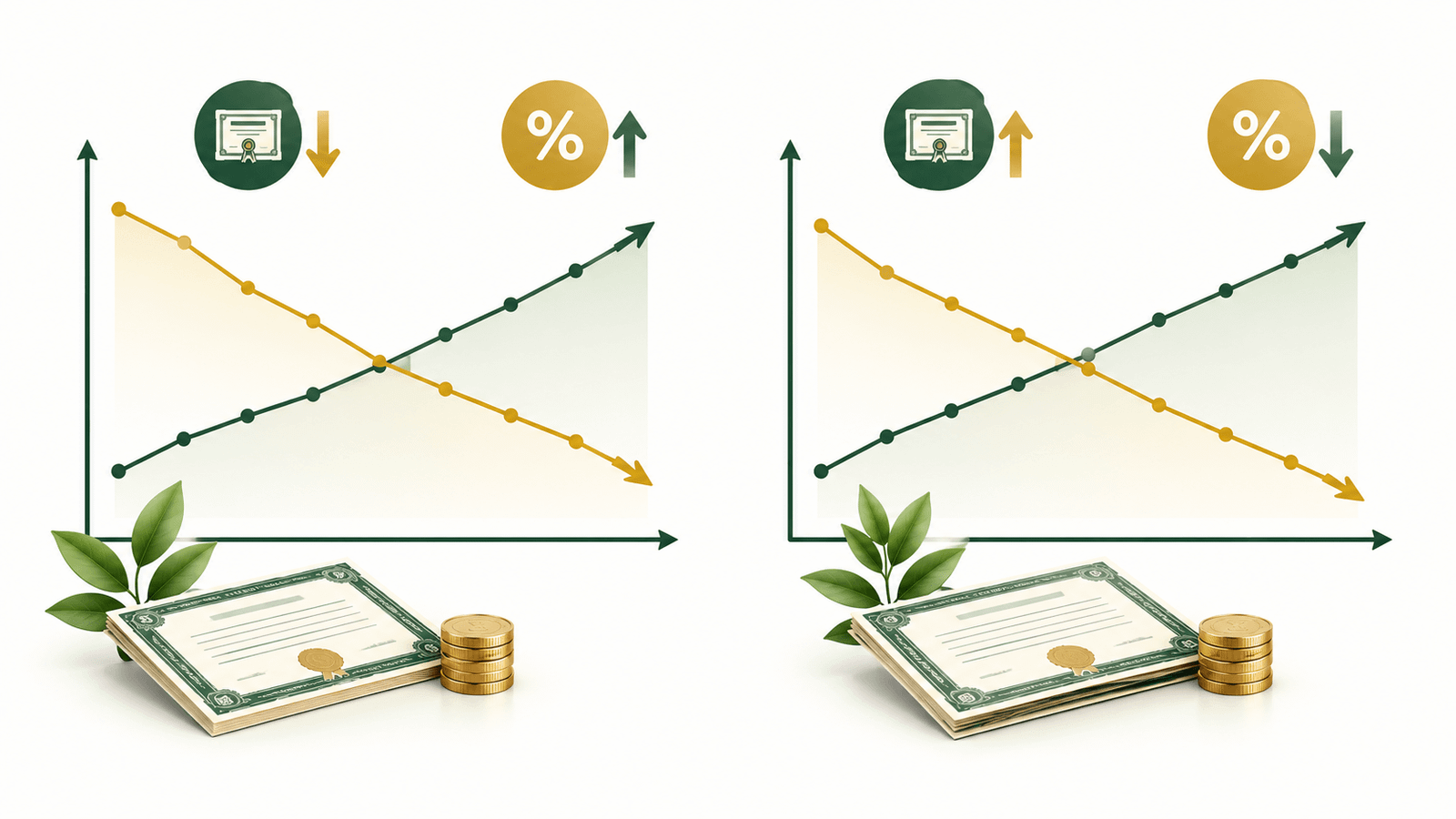
One of the most important relationships in fixed-income investing is that the prices of existing fixed-rate bonds generally move in the opposite direction to market interest rates. As a result, a bond’s yield generally rises when its market price falls and declines when its market price rises, all else being equal.
Consider a bond that pays $50 annually on a face value of $1,000.
If comparable newly issued bonds begin offering higher interest payments, the older bond may become less attractive. Its market price may fall until its income and other cash flows offer a more competitive return to buyers.
Conversely, if new bonds offer lower interest payments, an existing bond with a higher coupon may become more attractive. Its market price may rise, reducing its yield for a new buyer.
The relationship can be summarized as follows:
- Market interest rates rise → existing fixed-rate bond prices generally fall → their yields generally rise.
- Market interest rates fall → existing fixed-rate bond prices generally rise → their yields generally fall.
These relationships are not the only forces affecting bond prices. Credit risk, inflation expectations, liquidity, and changes in market demand can also influence prices and yields.
The SEC explains this relationship in its Investor Bulletin on interest rates and fixed-income investments.
What Factors Affect Bond Yield?
Bond yields are influenced by several economic and bond-specific factors.
1. Market Interest Rates
Changes in prevailing interest rates can affect the attractiveness and market price of existing bonds. When market rates rise, older fixed-rate bonds may need to trade at lower prices to compete with newer issues.
2. Credit Quality
Credit quality reflects the issuer’s ability to make interest and principal payments as required. Bonds issued by borrowers with weaker credit profiles often need to offer higher yields to compensate investors for taking on greater default risk.
A higher yield does not automatically make a bond a better investment. It may reflect a greater possibility of missed payments or losses.
3. Inflation Expectations
Inflation reduces the purchasing power of money received in the future. Investors may demand higher nominal yields when they expect inflation to rise, particularly for bonds with fixed payments.
The return after inflation, known as the real return, may be much lower than the quoted nominal yield.
4. Time to Maturity
Bonds with longer maturities can be more sensitive to changes in interest rates than otherwise comparable shorter-term bonds. Investors may require additional compensation for accepting greater interest-rate uncertainty.
However, long-term bonds do not always offer higher yields than short-term bonds. The relationship depends on market conditions and expectations.
5. Supply and Demand
The supply of bonds and the amount investors want to buy can influence market prices. Strong demand may push prices higher and yields lower, while weaker demand may put downward pressure on prices and upward pressure on yields.
6. Liquidity
Liquidity refers to how easily an investment can be bought or sold without substantially affecting its price. Bonds that are difficult to trade may require investors to accept less favorable prices or demand additional compensation for the inconvenience and risk.
What Does a High Bond Yield Mean?
A high bond yield means a bond offers a relatively high return according to the specific yield measure being considered. However, it does not necessarily mean the investment is safe or attractive.
A bond may have a high yield because:
- Its market price has fallen.
- The issuer has a higher risk of default.
- Investors expect inflation or interest rates to remain elevated.
- The bond has a longer maturity or other features that investors consider risky.
- The bond is less liquid than comparable alternatives.
For example, a financially strong government bond may offer a lower yield than a bond issued by a company facing financial difficulties. The company may need to offer a higher yield to attract buyers.
Investors should therefore compare yield alongside credit quality, maturity, liquidity, fees, taxes, and their own financial objectives.
Chasing the highest advertised yield without understanding the underlying risks can lead to losses.
What Are the Risks of Investing in Bonds?
Bonds can provide income and diversification, but they are not risk-free.
Interest Rate Risk
When market interest rates rise, the market price of an existing fixed-rate bond may fall. This matters particularly if you need to sell the bond before maturity.
Credit or Default Risk
An issuer may fail to make required interest payments or repay principal. In such cases, investors could lose some or all of their investment.
Inflation Risk
If inflation rises faster than the income earned on a bond, the investment’s purchasing power may decline.
Liquidity Risk
Some bonds trade infrequently. An investor who needs to sell quickly may struggle to find a buyer at a reasonable price.
Reinvestment Risk
When coupon payments or principal are received, the investor may have to reinvest that money at lower interest rates than before.
Call Risk
Some bonds allow the issuer to repay them before their scheduled maturity date. If a bond is called when market interest rates are lower, the investor may have difficulty finding a comparable investment offering the same yield.
Before investing, review the bond’s offering documents, credit quality, maturity, fees, and repayment terms. Learn more about these risks in the SEC’s bond investing resources.
How Can Investors Compare Bond Yields?
Investors should compare bonds using consistent measures and consider the risks attached to each investment.
Here are several practical steps:
- Compare similar bonds. Look at bonds with comparable maturities, credit quality, currencies, and structures.
- Check yield to maturity. When appropriate, YTM can help compare the potential returns of bonds trading at different prices.
- Understand the issuer. Review the issuer’s financial position, credit rating, and ability to meet its obligations.
- Consider inflation. Evaluate how inflation could affect the purchasing power of future payments.
- Review fees and taxes. Transaction costs, brokerage charges, and tax treatment can reduce the return you actually receive.
- Consider your time horizon. A bond’s maturity and price volatility should be compatible with when you expect to need your money.
- Avoid choosing by yield alone. A high yield may indicate additional risk rather than a superior investment opportunity.
Investors in different countries should also consider currency risk, local tax rules, and the regulations governing the bond market in their jurisdiction.
Frequently Asked Questions About Bond Yield
Is bond yield the same as interest rate?
No. A bond’s coupon rate determines its contractual interest payments relative to face value. Its yield measures income or return relative to its price and, depending on the calculation, may also include other cash flows.
Can bond yield change after purchasing a bond?
Yes. A bond’s market yield changes as its market price changes. For a fixed-rate bond, the contractual coupon payment generally remains unchanged, but its current yield and yield to maturity may change with the price.
Is a higher bond yield always better?
No. A higher yield may reflect greater credit risk, interest-rate risk, lower liquidity, or other disadvantages. Investors should evaluate the risks and terms before comparing returns.
What is the difference between current yield and yield to maturity?
Current yield divides the annual coupon payment by the current market price. Yield to maturity estimates the annualized return from the bond’s expected cash flows through maturity, including the effect of the purchase price and repayment at maturity.
Can you lose money investing in bonds?
Yes. Bond prices can fall, issuers can default, and selling before maturity may result in a loss. Even when payments are made as expected, inflation can reduce the purchasing power of the money received.
Do government bonds always provide guaranteed returns?
No investment should be assumed to be risk-free. Government bonds carry risks that depend on the issuer, currency, and terms. Some government securities have strong credit backing, but their market prices can still fluctuate, particularly when interest rates change.
Final Thoughts
Bond yield is a valuable measure for understanding the potential income and return of fixed-income investments. It helps investors compare bonds, evaluate the relationship between market prices and coupon payments, and assess how interest rates and credit quality may affect investment decisions.
The most important distinction is that coupon rate, current yield, and yield to maturity measure different things. Understanding these differences can help investors avoid misleading comparisons and make more informed choices.
A high yield alone is not enough to establish that a bond is suitable. Consider the issuer’s creditworthiness, maturity, inflation, liquidity, taxes, fees, and your own financial goals before investing.
For more practical financial education, explore the guides available on Finobloom.
Disclaimer: This article is for educational purposes only and does not constitute financial, investment, tax, or legal advice. Bond availability, risks, returns, and tax treatment vary by country and security. Consider consulting a qualified financial professional before making investment decisions.
3 thoughts on “Bond Yield Explained: How Bond Returns Work”