

Gross Domestic Product (GDP) is one of the most widely used measures of a country’s economic activity. Governments, investors, businesses, and economists use it to understand whether an economy is expanding, slowing down, or contracting. However, GDP can be confusing because a growing economy does not automatically mean every household is financially better off.
Understanding GDP helps you interpret economic news, make sense of financial markets, and understand how national economic conditions can affect jobs, prices, businesses, and investments.
In this guide, you will learn what GDP means, how it is calculated, the difference between nominal and real GDP, why GDP growth matters, and what this measure cannot tell you about an economy.
What Is Gross Domestic Product (GDP)?
Gross Domestic Product, commonly called GDP, is the total monetary value of all final goods and services produced within a country’s borders during a specific period, usually a quarter or a year.
The key word is within. GDP measures production inside a country, regardless of whether the producer is locally owned or foreign-owned.
For example, if a foreign automobile company manufactures cars at a factory in India, the value of the production taking place in India contributes to India’s GDP. Similarly, services delivered by businesses operating within a country can contribute to its GDP.
GDP includes many types of economic activity, such as:
- Manufacturing cars, electronics, clothing, and machinery.
- Constructing houses, offices, roads, and other infrastructure.
- Providing healthcare, education, transport, and financial services.
- Selling newly produced goods and services to consumers.
- Government-provided services and investment in public infrastructure.
GDP generally excludes the value of intermediate goods when their value is already included in the final product. This prevents the same production from being counted multiple times.
For example, if a bakery buys flour and uses it to produce bread, GDP counts the value of the finished bread rather than adding the full value of the flour and bread separately.
How Is GDP Calculated?
Economists can calculate GDP using different approaches. The expenditure approach is one of the most commonly discussed methods.
Its formula is:
GDP = C + I + G + (X − M)
Each component represents a different type of spending.
1. Consumption (C)
Consumption includes household spending on goods and services, such as food, clothing, transport, healthcare, entertainment, and housing services.
When households purchase more goods and services produced within the economy, consumption can contribute to GDP growth.
However, spending alone does not tell the entire story. If spending rises mainly because prices increase, real economic output may not grow by the same amount.
2. Investment (I)
In GDP calculations, investment refers primarily to spending on newly produced capital goods, structures, residential construction, and changes in business inventories.
Examples include:
- A company purchasing new manufacturing equipment.
- A business constructing a warehouse.
- A household purchasing a newly built home.
- A manufacturer increasing its inventory of finished goods.
Buying shares or bonds in the financial market is not directly counted as GDP investment. Those transactions transfer ownership of financial assets rather than directly creating new goods or services.
3. Government Spending (G)
Government spending includes purchases of goods and services, such as public administration, education services, infrastructure construction, and defence services.
Government transfer payments, such as certain pension benefits or unemployment benefits, are generally not counted directly as government purchases in this formula. They transfer income rather than represent payment for newly produced goods or services.
4. Net Exports (X − M)
Net exports equal exports minus imports.
- Exports (X): Goods and services produced domestically and sold to other countries.
- Imports (M): Goods and services purchased from other countries.
Exports add to domestic production because the goods or services are produced locally. Imports are subtracted because their production took place abroad, even though they may appear in consumption, investment, or government spending.
A country can therefore experience strong consumer spending without an equivalent increase in domestic production if much of that spending goes toward imported products.
A Simple Example of GDP Calculation
Imagine a fictional country with the following annual economic figures:
| GDP component | Value |
|---|---|
| Consumption (C) | $600 billion |
| Investment (I) | $150 billion |
| Government purchases (G) | $200 billion |
| Exports (X) | $100 billion |
| Imports (M) | $80 billion |
First, calculate net exports:
Net exports = $100 billion − $80 billion = $20 billion.
Then apply the GDP formula:
GDP = $600 billion + $150 billion + $200 billion + $20 billion.
GDP = $970 billion.
This simplified example shows how different types of spending contribute to total economic output. Actual national GDP calculations use detailed statistical methods and adjustments to avoid double-counting and improve accuracy.
Nominal GDP vs. Real GDP

One of the most important distinctions in economic analysis is the difference between nominal GDP and real GDP.
What Is Nominal GDP?
Nominal GDP measures production using the prices prevailing during the period being measured. It is not adjusted for changes in the overall price level.
Suppose a country produces 1,000 units of a product at $10 each. The total value is $10,000.
If it produces the same 1,000 units the following year but the price rises to $12, nominal GDP for that product becomes $12,000—even though production has not increased.
Nominal GDP can rise because an economy produces more, because prices rise, or because both happen.
What Is Real GDP?
Real GDP adjusts for price changes to provide a clearer picture of changes in the quantity of goods and services produced.
In the example above, if production remains at 1,000 units, real output has not increased simply because the price rose.
Real GDP is therefore particularly useful when comparing economic performance across different periods.
This distinction also helps explain the relationship between economic growth and inflation. Read our guide to inflation and how rising prices affect your money to understand why increasing prices can affect purchasing power even when nominal figures look stronger.
What Is GDP Growth?
GDP growth measures how much an economy’s output changes over time. It is commonly reported as a percentage change in real GDP.
The basic formula is:
GDP growth rate = [(Current real GDP − Previous real GDP) ÷ Previous real GDP] × 100
For example, suppose a country’s real GDP increases from $2 trillion to $2.1 trillion.
The increase is $100 billion.
GDP growth rate = ($100 billion ÷ $2 trillion) × 100 = 5%.
This means real economic output grew by 5% over the period being compared.
National statistics agencies may report growth quarterly, annually, or as an annualised quarterly rate. These figures are not always directly comparable, so it is important to check the period and calculation method.
What Does Positive GDP Growth Mean?
Positive real GDP growth generally indicates that an economy is producing more goods and services than it did during the comparison period.
It may accompany stronger business activity, increased investment, rising employment, or greater household income. However, these outcomes are not guaranteed for every industry or household.
What Does Negative GDP Growth Mean?
Negative real GDP growth means measured economic output has fallen over the period being compared.
A decline can occur because consumers spend less, businesses reduce investment, exports weaken, or production is disrupted.
One negative quarter does not automatically establish that an economy is in a recession. Analysts consider the wider economic picture, including employment, income, industrial production, and the duration of the slowdown.
GDP Per Capita: A Different Way to Compare Economies
Total GDP shows the overall size of an economy, but it does not account for population size.
GDP per capita divides GDP by the population:
GDP per capita = GDP ÷ Population
Suppose Country A has GDP of $1 trillion and a population of 100 million. Its GDP per capita is $10,000.
Country B has GDP of $800 billion and a population of 40 million. Its GDP per capita is $20,000.
Country A has the larger total economy, but Country B has the higher GDP per capita.
GDP per capita is useful for comparing average economic output relative to population. Nevertheless, it is not the same as average personal income, and it does not show how income is distributed among residents.
A country can have high GDP per capita while many people experience financial hardship. To understand individual financial well-being, other measures—such as household income, poverty rates, access to services, and wealth distribution—are also important.
Why Does GDP Matter?
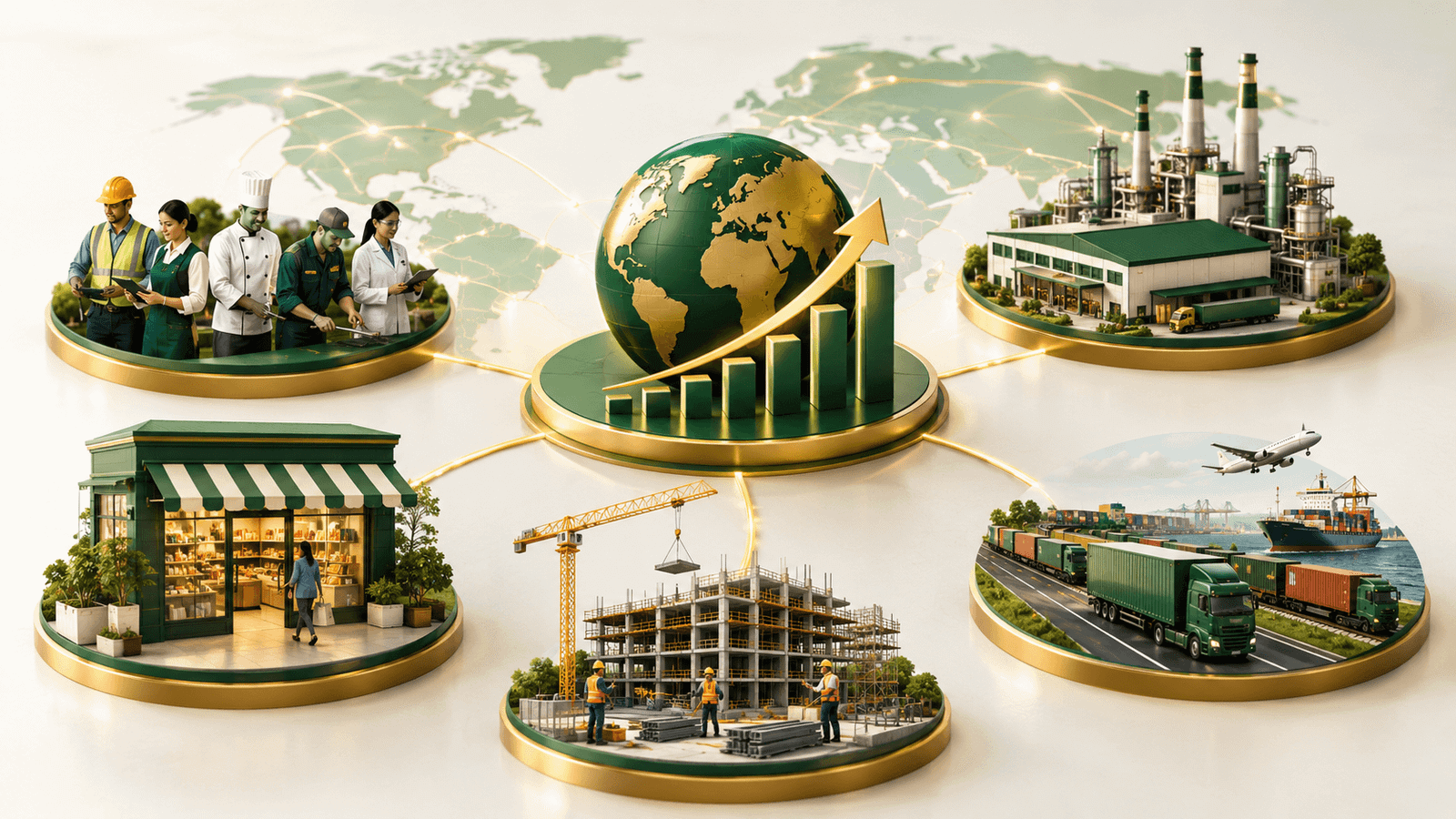
GDP is useful because it provides a broad view of economic activity. Its effects can reach households, businesses, governments, and investors.
1. It Helps Governments Make Economic Decisions
Governments use GDP data alongside inflation, employment, tax revenue, and other indicators when developing economic policies.
If economic activity slows, policymakers may consider measures to support demand or investment. If the economy is growing rapidly while inflation pressures are strong, they may assess different policy options.
GDP is an important input, not the only factor that determines a policy decision.
2. It Helps Businesses Plan for the Future
Businesses monitor GDP trends when making decisions about expansion, hiring, production, and investment.
For example, a company selling consumer products may expect stronger demand during a period of healthy economic growth. If growth weakens, it may review inventory levels or delay expansion.
The effect varies by industry. Essential services, export-oriented businesses, and luxury retailers may respond differently to the same economic conditions.
3. It Provides Context for Investors
Economic growth can influence company earnings, government revenue, interest rates, and market expectations. Investors therefore monitor GDP releases when assessing the wider economic environment.
However, strong GDP growth does not guarantee rising stock prices. Markets also respond to valuations, interest rates, corporate profits, investor expectations, and global events.
GDP should be considered alongside other indicators rather than used as a stand-alone investment signal.
4. It Helps Explain Employment Trends
When businesses increase production, they may need more workers. This can support employment and household income.
But the relationship is not automatic. Companies can increase output through automation, productivity improvements, or longer working hours without hiring proportionately more workers.
A complete employment assessment therefore includes job creation, unemployment, wages, and labour-force participation.
5. It Helps Compare Economic Performance
GDP allows analysts to compare the scale and growth of different economies.
However, comparisons need care. Exchange rates affect GDP figures converted into a common currency, while differences in local prices affect how much people can buy with their income.
For some international comparisons, purchasing power parity (PPP) measures can provide additional context by accounting for differences in price levels between countries.
What GDP Cannot Tell You
GDP is powerful, but it is not a complete measure of a country’s success or residents’ financial well-being.
GDP Does Not Show Income Inequality
A country may experience rapid GDP growth while most additional income goes to a relatively small part of the population.
Total output can rise without an equal improvement in living standards for everyone.
GDP Does Not Measure Every Aspect of Quality of Life
GDP does not directly measure health, happiness, personal safety, leisure time, or the quality of education. These factors can matter greatly to people’s lives even when they are not fully reflected in market production.
GDP Can Miss Some Unpaid Work
Unpaid household activities, such as caring for family members or preparing meals at home, are generally not valued in the same way as equivalent paid market services.
Consequently, GDP does not capture all economically valuable work.
GDP Does Not Fully Account for Environmental Damage
Production can increase GDP while also contributing to pollution, resource depletion, or environmental harm. GDP alone does not subtract all such costs.
GDP Growth Does Not Guarantee Better Personal Finances
An economy may grow while some households face rising living costs, stagnant wages, or increasing debt.
Your personal financial position depends on factors such as income, expenses, savings, debt, and financial decisions—not just national economic growth. A practical starting point is to build a personal financial plan that reflects your own goals and circumstances.
GDP vs. GNP: What Is the Difference?
GDP and Gross National Product (GNP) measure related but different aspects of economic activity.
- GDP measures production within a country’s borders.
- GNP measures income earned by a country’s residents and businesses from production, including relevant net income from abroad under the national accounting framework.
For example, production at a foreign-owned factory located in India contributes to India’s GDP. The treatment of the income earned by the foreign owner can differ when measuring national income.
Many countries and international organisations also use Gross National Income (GNI), which measures income received by residents, including net primary income from abroad.
These measures answer different questions. GDP focuses on domestic production, while GNI and related national-income measures help describe income accruing to residents.
Where Can You Find Reliable GDP Data?
For accurate figures, use official national statistical agencies and recognised international organisations rather than relying only on headlines or social media posts.
Useful sources include:
- World Bank Data — country-level GDP data and related indicators.
- International Monetary Fund (IMF) — global economic outlooks, forecasts, and analysis.
- U.S. Bureau of Economic Analysis (BEA) — detailed U.S. GDP statistics and explanations.
When reviewing GDP figures, check whether the data is nominal or real, the currency and price basis, the time period, and whether the number is an estimate or a revised release. GDP estimates are often updated as more complete information becomes available.
Frequently Asked Questions About GDP
Is a higher GDP always better?
A larger GDP generally indicates a larger volume or value of economic activity, but it does not automatically mean everyone is better off. Population size, inflation, inequality, environmental costs, and quality of life also matter.
Can GDP increase while people become poorer?
Yes. Nominal GDP can rise because prices increase even if real output changes little. Even when real GDP grows, gains may not be shared evenly, and household living costs may rise faster than some incomes.
What is the difference between GDP and GDP growth?
GDP is a measure of economic output over a period. GDP growth is the percentage change in that output between two periods, usually measured using real GDP when assessing changes in production.
Why is real GDP important?
Real GDP adjusts for price changes, helping analysts determine whether the quantity of goods and services produced has increased or decreased rather than merely reflecting inflation.
Does GDP include imports?
Imports are subtracted in the expenditure formula because they represent production from outside the domestic economy. They may already be included in consumption, investment, or government spending, so subtracting them helps ensure the measure focuses on domestic production.
How often is GDP reported?
Many economies publish quarterly GDP estimates and annual figures. Release schedules, methods, and revision policies vary by country.
Final Thoughts
Gross Domestic Product is a key measure for understanding the size and direction of an economy. It helps explain economic growth, business conditions, government decisions, and some of the broader forces that influence financial markets.
To interpret GDP correctly, distinguish nominal GDP from real GDP, understand GDP per capita, and look beyond headline growth rates. Employment, inflation, income distribution, productivity, and household living standards all provide additional information.
For personal financial decisions, GDP is best treated as economic context—not a prediction of what will happen to your income or investments. Combining reliable economic information with a sound personal financial plan gives you a more complete foundation for making informed money decisions.
3 thoughts on “GDP Explained: What Gross Domestic Product Measures and Why It Matters”