

Your credit card limit is not just a spending allowance. How much of that limit you use can influence how lenders assess your creditworthiness. This is where your credit utilization ratio comes in.
Credit utilization measures the amount of revolving credit you are using compared with the total credit available to you. It is an important factor in many credit-scoring models, particularly in the United States. Understanding it can help you manage credit cards more responsibly, avoid unnecessary debt, and build healthier financial habits.
In this guide, you will learn how credit utilization works, how to calculate it, what percentage to aim for, and practical ways to improve it without spending more money.
What Is a Credit Utilization Ratio?
Credit utilization ratio is the percentage of your available revolving credit that you are currently using.
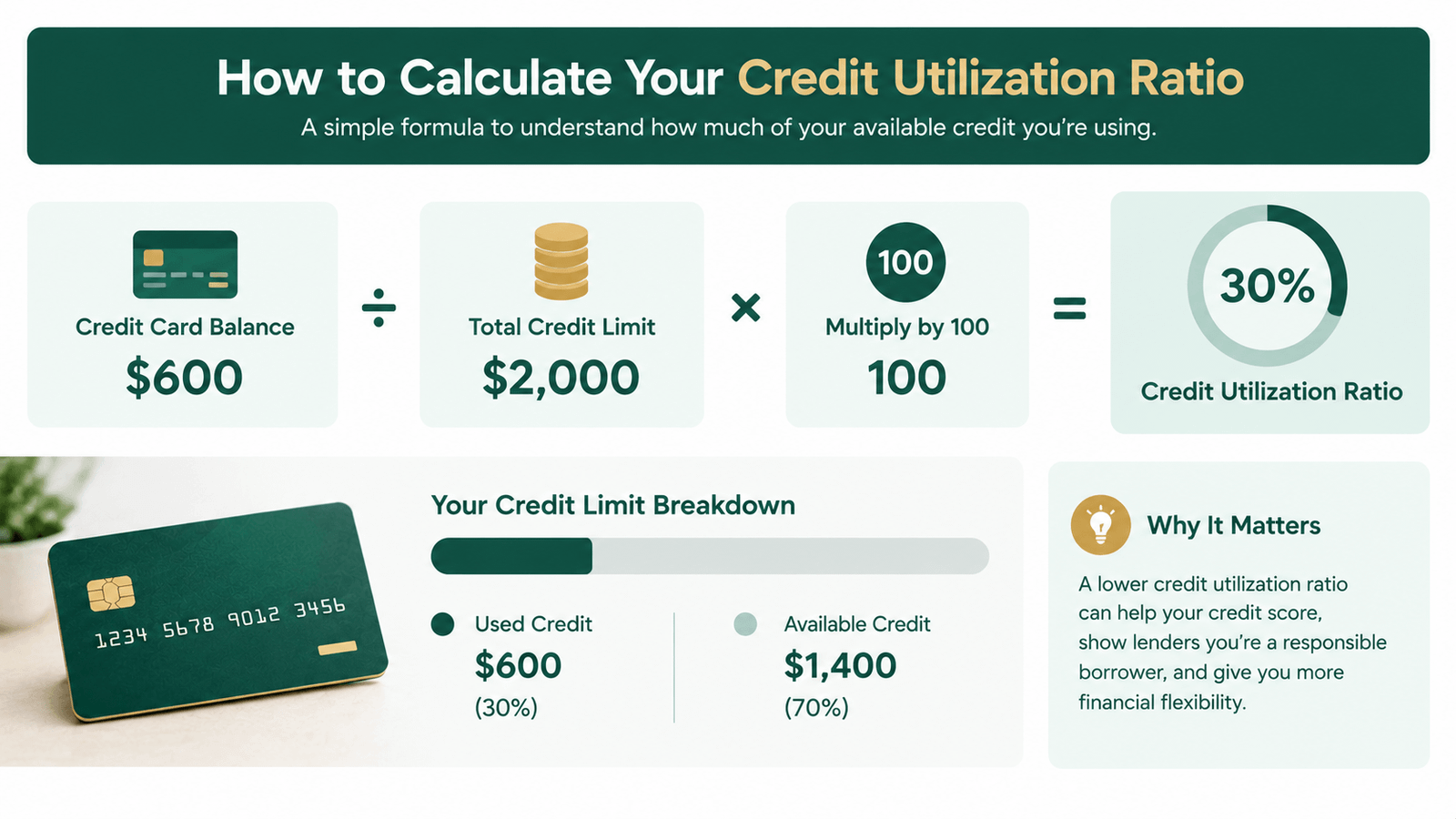
For example, suppose your credit card has a limit of $2,000 and your outstanding balance is $600. Your utilization ratio is 30%.
The calculation is straightforward:
Credit utilization ratio = (Outstanding credit card balance ÷ Total credit limit) × 100
Using the example above:
($600 ÷ $2,000) × 100 = 30%
A lower utilization ratio generally indicates that you are using a smaller portion of your available credit. In many US credit-scoring models, lower utilization is generally better for your score, although its exact impact varies.
Credit utilization is different from your payment history. Paying your bills on time is essential, but keeping your reported credit card balances manageable can also matter.
If you are new to credit scores, start with our guide to Credit Score Explained: How It Works and How to Improve It.
How Does Credit Utilization Work?
Credit utilization is commonly considered at two levels: individual-card utilization and overall utilization.
1. Individual Credit Card Utilization
This measures how much of one card’s limit you are using.
Imagine you have a credit card with a $1,000 limit and a balance of $700. Your utilization on that card is 70%.
Even if you have other cards with unused credit, a high balance on an individual card can still be relevant to certain scoring models.
2. Overall Credit Utilization
Overall utilization considers the combined balances and credit limits across your eligible revolving accounts.
Suppose you have two credit cards:
| Credit card | Credit limit | Balance |
|---|---|---|
| Card A | $2,000 | $500 |
| Card B | $3,000 | $400 |
| Total | $5,000 | $900 |
Your overall utilization is:
($900 ÷ $5,000) × 100 = 18%
In this example, your overall utilization is 18%, even though the utilization on each card is different.
Both individual-card and overall utilization can matter, depending on the credit-scoring model used by a lender.
What Is a Good Credit Utilization Ratio?
You may have heard that you should keep credit utilization below 30%. This is a useful general guideline, but it is not a universal threshold that guarantees a particular credit score.
For many US credit-scoring models, lower utilization is generally preferable, and people with the strongest scores often have low reported revolving balances.
Here is a simplified illustration using a credit limit of $5,000:
| Utilization | Balance on a $5,000 limit |
|---|---|
| 10% | $500 |
| 20% | $1,000 |
| 30% | $1,500 |
| 50% | $2,500 |
| 80% | $4,000 |
These percentages are examples, not official score bands. Crossing a particular percentage does not automatically cause a fixed increase or decrease in your score.
If your goal is to maintain a healthy credit profile, try to keep reported balances low relative to your limits while paying every bill on time.
You do not need to carry a balance or pay interest to build a credit history. Paying your statement balance in full by the due date, when financially possible, can help you avoid interest on purchases under the terms of your card agreement.
When Is Credit Utilization Reported?
Your credit card balance can change throughout the month as you make purchases and payments. However, the balance that appears on your credit report may not be the same as your current balance.
In the United States, many card issuers report account information to credit bureaus periodically, often around the statement closing date. Practices vary by issuer, so the reported balance may reflect a snapshot rather than the amount you owe today.
For example, suppose your credit limit is $2,000 and your balance reaches $900 during the month. You then pay $500 before the issuer reports your account.
If the reported balance is $400, the utilization shown for that account would be 20%, rather than 45%.
The exact timing depends on the issuer and reporting practices. Check your card agreement or ask your issuer when it reports account balances.
Remember that a balance appearing on a credit report is not necessarily overdue debt. The reported amount and the amount due on your next bill serve different purposes.
7 Practical Ways to Improve Your Credit Utilization
You do not need complicated financial products to manage your credit utilization. Consistent habits can make a meaningful difference.

1. Pay Down Existing Credit Card Balances
One of the most direct ways to reduce utilization is to lower your outstanding balances.
If your card has a $2,000 limit and a $1,000 balance, your utilization is 50%. Reducing the balance to $400 brings it down to 20%.
Focus on paying down balances without neglecting essential expenses or missing minimum payments on other accounts. Avoid taking on new debt simply to improve a credit score.
2. Pay More Than the Minimum When You Can
Minimum payments help keep an account in good standing when made on time, but they may reduce your balance slowly because interest and fees can consume part of each payment.
Paying more than the minimum, whenever your budget allows, can help reduce outstanding debt faster.
To understand the cost of carrying a balance, read our guide to Credit Card Interest Explained: How APR Works and What It Costs.
3. Consider Making Payments Before the Statement Closes
If your balance tends to be high near the end of the billing cycle, making an additional payment before the statement closing date may reduce the balance that gets reported.
For instance, you could make a payment after receiving your salary rather than waiting until the due date, provided your essential expenses remain covered.
This is an optional cash-flow strategy, not a requirement. Your payment must still reach the issuer by the due date, and reporting dates differ between issuers.
4. Avoid Unnecessary Credit Card Spending
A higher credit limit does not mean you have more income. Spending more simply because credit is available can lead to expensive debt.
Review your card transactions regularly and identify purchases that do not fit your budget. Setting a personal spending limit below your card’s official limit can help you maintain control.
Our guide to How to Create a Personal Spending Plan That Actually Works can help you allocate money toward bills, savings, and debt payments.
5. Be Careful Before Closing an Old Credit Card
Closing a credit card can reduce your total available credit. If you continue carrying the same balances, your overall utilization may rise.
For example, suppose you have two cards with a combined limit of $5,000 and balances of $1,000. Your utilization is 20%.
If you close a card with a $3,000 limit and your remaining limit is $2,000, your utilization becomes 50% while the balance remains $1,000.
This does not mean you should keep every card open indefinitely. Annual fees, fraud concerns, overspending risks, and account terms are also important. Make the decision based on your overall financial situation rather than utilization alone.
6. Request a Credit Limit Increase Only If It Makes Financial Sense
A higher credit limit can reduce your utilization ratio if your balances remain unchanged.
For example, a $600 balance on a $2,000 limit represents 30% utilization. If the limit increases to $3,000, the same balance represents 20%.
However, issuers may review your credit profile or income before approving an increase. A request can also involve a credit inquiry, depending on the issuer’s process.
Do not request a higher limit if it is likely to encourage additional spending. An increase is not guaranteed, and it should never replace a plan to manage debt.
7. Monitor Your Credit Reports and Statements
Reviewing your statements can help you catch unfamiliar transactions, incorrect balances, fees, and other problems early.
In the United States, consumers can use AnnualCreditReport.com to access credit reports from the major nationwide credit reporting companies. Check the current terms and availability when requesting reports.
If a balance or account is inaccurate, contact the issuer or relevant credit bureau and follow its dispute process.
Monitoring your credit is useful, but you do not need to check your score every day. Focus on accurate information, manageable debt, and reliable payment habits.
Does Credit Utilization Affect Your Credit Score?
Credit utilization can influence credit scores that use revolving-credit balances as a scoring factor. In the United States, the FICO scoring model considers amounts owed, including revolving credit utilization, among several factors.
However, credit utilization is only one part of a credit profile. Payment history, length of credit history, new credit, and other factors can also affect a score, depending on the scoring model.
A low utilization ratio cannot compensate for every other credit problem, and a high ratio does not guarantee a specific score outcome.
It is also important to distinguish between scoring systems. Credit-reporting and scoring practices differ across countries. If you live outside the United States, check how your local credit bureau or lender evaluates credit card balances.
For authoritative background on credit reports and scores in the United States, consult the Consumer Financial Protection Bureau.
Common Credit Utilization Mistakes to Avoid
Even people who understand credit utilization can make mistakes. Watch out for these common ones:
- Assuming 30% is a guaranteed safe limit: It is a general guideline, not a universal scoring rule.
- Paying late while focusing only on utilization: Payment deadlines remain important.
- Carrying a balance to build credit: You generally do not need to pay interest to build credit history.
- Maxing out a card because you can afford the minimum payment: Minimum payments do not make expensive borrowing harmless.
- Opening several cards just to increase available credit: New applications can have consequences, and extra credit can create more opportunities to overspend.
- Closing cards without checking the impact: Closing an account can change available credit and utilization.
- Assuming every country uses the same scoring model: Local rules and reporting systems differ.
The best approach is to manage your credit responsibly rather than chasing a single percentage.
Frequently Asked Questions
Is 30% credit utilization good?
Keeping utilization below 30% is a common guideline, but lower utilization may be better for many US scoring models. No specific percentage guarantees a particular score.
Is 0% credit utilization bad?
A low or zero reported balance is not automatically bad. You do not need to carry debt or pay interest to build a credit history. Other credit-profile factors still matter.
Should I pay my credit card before the statement date?
An early payment can reduce the balance reported by some issuers. Confirm your issuer’s reporting practices, and always make at least the required payment by the due date.
Does credit utilization affect my score immediately?
Changes may affect your score after updated account information reaches a credit bureau and the relevant scoring model evaluates it. Timing varies, and results are not guaranteed.
Can a credit limit increase improve utilization?
It can lower your utilization ratio if your balance stays the same. But approval is not guaranteed, and increasing your limit should not lead to more borrowing than you can repay.
Does credit utilization matter in India?
Indian credit bureaus and lenders use their own reporting and scoring practices. Credit card balances and repayment behavior can be relevant to creditworthiness, but US-specific percentages and scoring rules should not automatically be applied to Indian credit scores. Check the guidance provided by your bureau and lender.
Final Thoughts
Credit utilization is a useful measure of how much revolving credit you use compared with what is available. Keeping balances manageable, paying bills on time, avoiding unnecessary spending, and checking your statements can help you develop healthier credit habits.
You do not need to obsess over a perfect percentage. Instead, focus on paying down expensive debt, keeping your finances organized, and using credit only when it fits your budget.
The goal is not simply to improve a number. It is to build a financial life in which credit supports your plans rather than becoming a burden.
1 thought on “Credit Utilization Ratio Explained: What It Is and How to Improve It”