
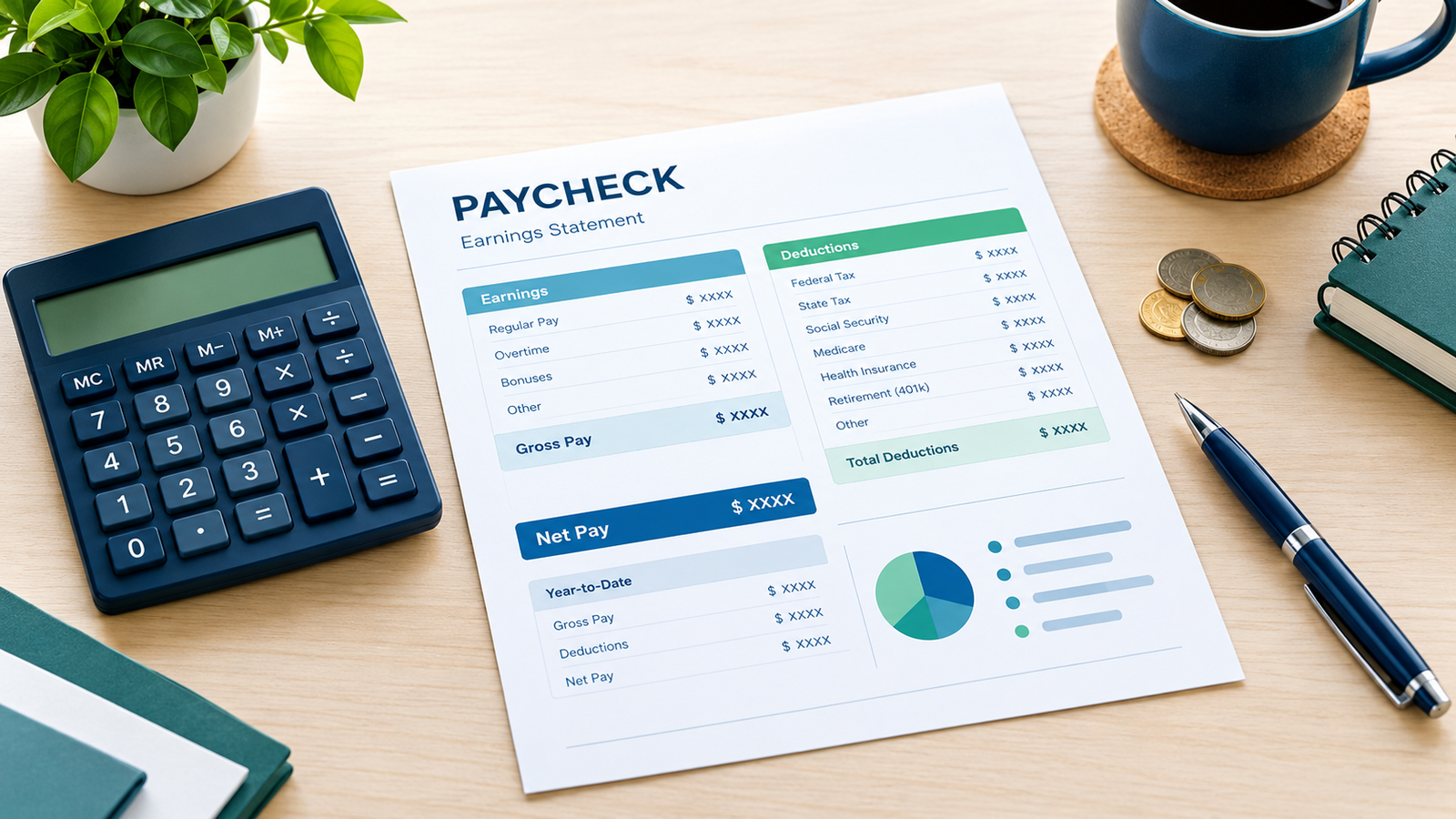
How to read a pay stub is an important money skill that helps you understand your earnings, deductions, and take-home pay. Your pay stub explains where your money comes from, how much is deducted, and how much you actually receive.
Understanding a pay stub can help you spot payroll mistakes, manage your budget, and make better financial decisions. Whether you work full-time, part-time, or earn an hourly wage, learning to read your pay stub is an important money skill.
In this guide, you will learn what gross pay and net pay mean, how common deductions work, which numbers deserve your attention, and how to use your pay stub to improve your finances.
What Is a Pay Stub?
A pay stub is a document that explains how your employer calculated your pay for a particular pay period. Depending on your country and employer, it may be available as a printed document, a PDF, or an online payroll record.
A pay stub usually includes:
- Your gross earnings before deductions
- Taxes and other deductions
- Your net pay after deductions
- Your pay period and payment date
- Hours worked and hourly rates, when applicable
- Year-to-date earnings and deductions
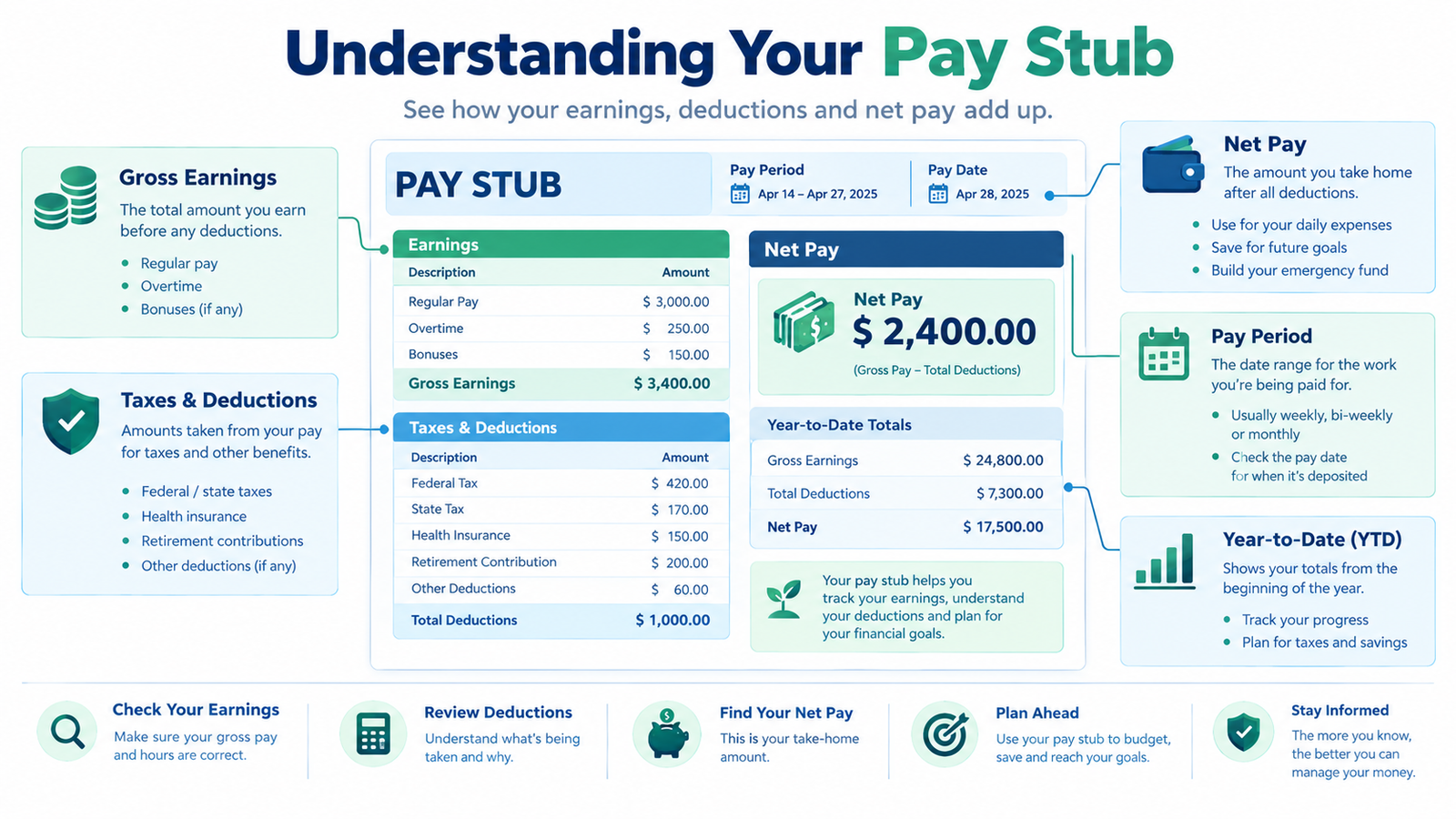
Your pay stub is different from your bank statement. Your bank statement shows the money deposited into your account, while your pay stub explains how that payment was calculated.
Reviewing both can help you confirm that the amount deposited matches your expected take-home pay.
1. Understand Gross Pay
Gross pay is the total amount you earn before taxes and other deductions are taken out.
For example, suppose you earn $20 per hour and work 40 hours in one week.
Your regular gross pay would be:
$20 × 40 hours = $800
Your gross pay may also include overtime, bonuses, commissions, or other earnings, depending on your job and employment agreement.
If you receive a fixed salary, your gross pay is generally based on your salary and pay schedule. However, unpaid leave, bonuses, overtime eligibility, or other adjustments may affect the amount shown for a particular period.
What to check: Compare the hours worked, pay rate, salary amount, and additional earnings on your pay stub with your own records.
If something does not match, ask your payroll department or employer for an explanation.
2. Understand Net Pay: The Money You Actually Receive
Net pay is the amount left after applicable deductions are subtracted from your gross pay. It is commonly called take-home pay.
For example, imagine your pay stub shows:
- Gross pay: $800
- Total deductions: $150
- Net pay: $650
The calculation is:
$800 − $150 = $650

Your employer would generally pay you $650 for that period, although the exact payment process depends on your employment arrangement.
Net pay is especially important when creating a budget because it is usually the amount available to cover your regular expenses, savings, debt payments, and personal spending.
If you want to understand where your money goes each month, start by comparing your take-home pay with the expenses in your monthly budget.
3. Learn What Paycheck Deductions Mean
Deductions are amounts subtracted from your gross earnings before your net pay is calculated. Some deductions are required by law, while others may depend on your benefits, employment agreement, or personal choices.
Common deductions include the following.
Income Taxes
Employers in many countries withhold income tax from employees’ pay. The amount may depend on your earnings, tax rules, declarations, and other personal circumstances.
The amount withheld from one paycheck is not always the same as your final tax liability. Your final tax calculation may depend on your total annual income and other relevant factors.
Check whether your tax withholding looks reasonable for your circumstances. If you believe it is incorrect, consult your payroll department or the relevant tax authority.
Social Insurance or Payroll Contributions
Depending on the country, employees may contribute toward social security, pensions, health insurance, or other government programs.
These deductions can have different names and rules in different countries. For that reason, avoid assuming that a deduction used in one country works the same way elsewhere.
Health Insurance and Employee Benefits
Some employers deduct the employee’s share of health insurance premiums or other benefits from their pay.
Your pay stub may show the amount deducted for a particular pay period. Compare it with your benefits enrollment information so you can identify unexpected changes.
Retirement Contributions
You may contribute part of your earnings to a workplace retirement plan or pension scheme. In some plans, your employer may contribute additional money.
Check the contribution amount and percentage if these details appear on your pay stub. Also review your plan documents to understand eligibility, employer matching, fees, and withdrawal rules.
Other Deductions
Other deductions can include union dues, certain employee benefit costs, or legally authorized deductions.
If you do not recognize a deduction, do not ignore it. Ask your employer or payroll team what it represents and how the amount was calculated.
For a general explanation of paycheck calculations, you can review the Consumer Financial Protection Bureau’s guide to understanding a paycheck.
4. Check Your Pay Period and Pay Date
Your pay period is the period of work covered by a paycheck. Your pay date is the date the money is paid to you.
Common schedules include weekly, every two weeks, twice a month, or monthly. The exact schedule depends on your employer and local rules.
Understanding your pay schedule can help you plan bills and avoid spending money that you need for upcoming expenses.
For example, someone paid every two weeks may receive 26 paychecks in a typical year, while someone paid twice a month generally receives 24. These schedules are not interchangeable.
If a paycheck seems unusually large or small, check whether the pay period includes a different number of working days, overtime, unpaid leave, a bonus, or another adjustment.
5. Understand Year-to-Date (YTD) Figures
Year-to-date, or YTD, figures show the accumulated totals from the beginning of the relevant year through the current pay period.
Your pay stub may display YTD totals for:
- Gross earnings
- Taxes withheld
- Retirement contributions
- Benefits deductions
- Net pay
These figures help you track your income and deductions over time instead of looking at only one paycheck.
For example, if your current paycheck shows gross pay of $800 and your YTD gross pay is $8,000, the YTD figure represents accumulated earnings rather than just the current payment.
Remember that the relevant year may be a calendar year or another period depending on the figure and your country’s rules. Check the labels on your pay stub.
6. How to Check Your Pay Stub for Errors
A quick review after every payday can help you catch mistakes early.
Step 1: Verify Your Personal Details
Check your name, employee information, and other identifying details. If something is incorrect, tell your employer so the record can be corrected.
Step 2: Check Your Hours and Pay Rate
If you are paid hourly, compare the hours shown with your timesheet or work records. Check regular hours, overtime, and any other earnings that apply to you.
If you receive a salary, confirm that your regular pay and any adjustments make sense.
Step 3: Review Every Deduction
Look for unfamiliar deductions or sudden changes in the amounts withheld. Compare them with earlier pay stubs, benefit selections, and any notices from your employer.
A change is not necessarily a mistake, but you should understand the reason behind it.
Step 4: Compare Net Pay With Your Bank Deposit
Check whether the payment received matches the net pay shown on your pay stub. If the amounts differ, confirm whether there was another payment, adjustment, or payroll issue.
Step 5: Compare With Your Previous Pay Stub
Keep your previous pay stubs so you can notice changes in earnings, taxes, contributions, or benefits.
If your hours and pay rate have stayed the same but your net pay changes significantly, review the deductions and ask payroll for clarification.
The U.S. Department of Labor’s wage-recordkeeping guidance explains the types of wage and payment records covered by U.S. federal recordkeeping rules. Rules vary by country, so use the appropriate local authority if you work outside the United States.
7. What to Do if Your Paycheck Looks Wrong
If you find a possible error, act promptly and keep a record of what you discover.
First, compare the pay stub with your timesheet, employment agreement, and previous pay records. Note the specific amount or deduction you believe is incorrect.
Next, contact your payroll department or manager. Explain the issue clearly and provide supporting details, such as the dates worked and the amount you expected to receive.
Keep copies of your pay stubs, messages, and any response you receive. If the problem is not resolved, check the employment standards or labor authority that applies to your location.
Do not assume that every difference is a violation. Some changes may result from tax withholding, benefits, unpaid leave, or other legitimate adjustments. The important thing is to understand the calculation and seek correction when necessary.
8. Use Your Pay Stub to Improve Your Budget
Your pay stub is more than a payroll document. It can help you understand your real income and make a practical financial plan.
Build Your Budget Around Take-Home Pay
Use your regular net pay as the starting point for your budget. Avoid building your spending plan around gross income because deductions reduce the money available to you.
List essential expenses such as housing, food, utilities, transport, and minimum debt payments. Then decide how much you can put toward savings and discretionary spending.
Our guide on building a monthly budget that actually works can help you organize these expenses.
Make Saving a Priority
After covering essential expenses, set aside a realistic amount for savings. Even a modest contribution made consistently can help you prepare for unexpected costs.
If you do not yet have a financial safety net, start by building an emergency fund. The amount you need depends on your expenses, income stability, and personal circumstances.
Review Changes in Your Income
If your net pay increases, avoid immediately increasing all your spending. Consider directing part of the extra money toward savings, debt repayment, or important financial goals.
If your take-home pay decreases, review the reason before making major decisions. You may need to adjust your budget or ask payroll to explain the change.
Track Your Income Over Time
Reviewing several pay stubs can help you identify patterns in your earnings and deductions. This is particularly useful if you work variable hours, earn commissions, or receive seasonal income.
Use these records when you create a personal financial plan that reflects your income, expenses, savings goals, and changing circumstances.
9. Pay Stub vs. Bank Statement vs. Tax Return
These documents serve different purposes.
Pay stub: Shows how your employer calculated your earnings, deductions, and take-home pay for a particular period.
Bank statement: Shows money deposited into or withdrawn from your bank account, along with other account transactions.
Tax return: Reports relevant income and tax information to the tax authority and helps determine your final tax position under the applicable rules.
Keeping these documents organized makes it easier to check payments, prepare tax information, and understand your finances.
Store them securely because they may contain personal and financial information.
Frequently Asked Questions
Is gross pay the same as salary?
Not always. Salary usually refers to an agreed amount of compensation, often expressed annually or monthly. Gross pay refers to earnings before deductions for a particular pay period and may include salary, overtime, bonuses, or other earnings.
Why is my net pay lower than my gross pay?
Your net pay is lower because taxes and other applicable deductions are subtracted from gross pay. The types and amounts of deductions depend on your location, employment arrangement, benefits, and personal circumstances.
Should I keep my pay stubs?
Yes. Keeping pay stubs can help you verify earnings, review deductions, resolve payroll questions, and prepare financial or tax records. How long you should keep them depends on your circumstances and local requirements.
What should I do if I do not understand a deduction?
Ask your payroll department for the deduction’s name, purpose, and calculation. Compare the explanation with your benefits documents or applicable local rules. Seek guidance from the relevant labor or tax authority if necessary.
Can my pay stub help me save money?
Yes. It helps you identify your actual take-home income, track deductions, and build a budget based on the amount available to spend and save.
Final Thoughts
Learning how to read a pay stub gives you a clearer picture of your income. By understanding gross pay, net pay, deductions, pay periods, and year-to-date totals, you can spot potential errors and make better financial decisions.
Make it a habit to review your pay stub after every payday. Check that your earnings are correct, understand every deduction, and compare your net pay with the amount deposited into your account.
Small financial habits can make a meaningful difference over time. When you know where your money goes, you can budget more confidently, save consistently, and work toward your financial goals.
1 thought on “How to Read a Pay Stub: Gross Pay, Net Pay, and Deductions”