

Learning how to stop living paycheck to paycheck can help you take control of your money, manage everyday expenses, and build a more secure financial future.
Have you ever received your salary, paid your bills, bought groceries and covered everyday expenses, only to realize that almost nothing is left?
You are not alone. Many people struggle to make their income last until their next payday. Even people with regular jobs can find themselves depending on every paycheck to cover their basic needs.
Living paycheck to paycheck can make unexpected expenses stressful. A medical bill, car repair, delayed payment or sudden household expense can disrupt your entire budget.
The good news is that you can start improving your financial situation with small, realistic changes. You do not necessarily need a high income to begin managing your money better. You need a clear understanding of where your money goes and a plan that fits your circumstances.
In this guide, you will learn nine practical steps to stop living paycheck to paycheck and start building greater financial stability.
1. Understand Where Your Money Goes
The first step is to understand how much money you receive and how much you spend.
Many people know their monthly income but underestimate their total expenses. Small purchases, delivery fees, subscriptions and impulse spending can gradually consume a significant portion of a budget.
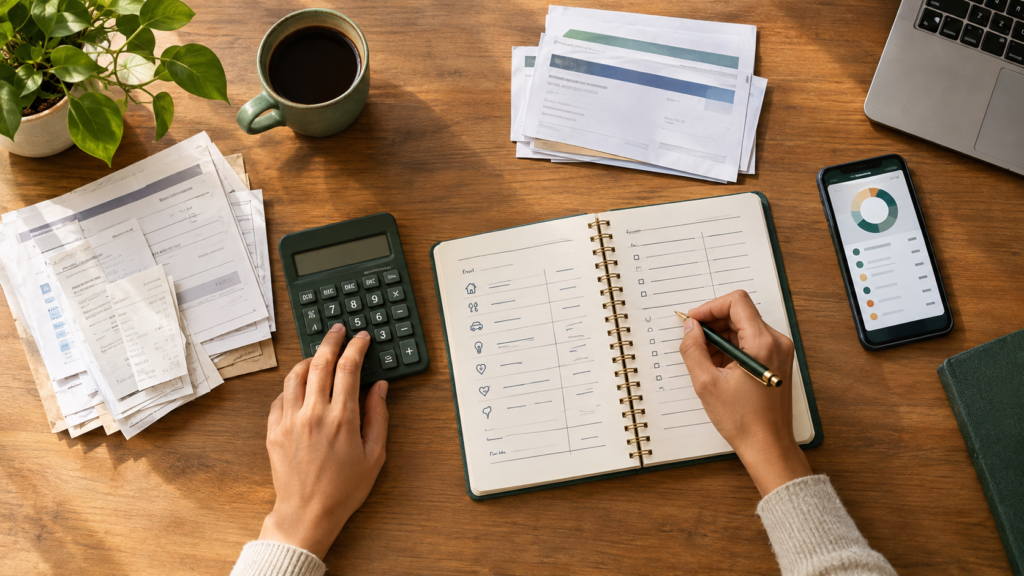
For the next 30 days, record your spending. You can use a notebook, spreadsheet or budgeting app.
Divide your expenses into three categories:
- Essential expenses: Housing, groceries, utilities, transport and necessary healthcare.
- Financial commitments: Loan payments, insurance and other required payments.
- Non-essential expenses: Entertainment, unnecessary shopping and subscriptions you rarely use.
At the end of the month, review your records. Look for expenses you can reduce without sacrificing your basic needs.
You cannot make an effective financial plan if you do not know where your money is going.
2. Create a Realistic Monthly Budget
A budget gives every part of your income a purpose.
Start with your take-home income, which is the money you actually receive after deductions. Then subtract your essential expenses and required payments.
Whatever remains can be divided between savings, flexible spending and other financial goals.
Some people use the 50/30/20 budgeting rule as a starting point:
- 50% for needs
- 30% for wants
- 20% for savings and debt repayment
However, this rule does not work for everyone. If housing costs are high or your income is limited, your essential expenses may take up more than half your income.
Do not feel pressured to follow a percentage perfectly. Build a budget around your real circumstances and adjust it when necessary.
A realistic budget that you can maintain is more useful than a perfect budget you abandon after one week.
For more help with budgeting, explore the Consumer Financial Protection Bureau’s budgeting resources.
For a more detailed guide, read our article on How to Build a Monthly Budget That Actually Works.
3. Pay Attention to Your Biggest Expenses
Cutting small expenses can help, but large recurring costs often have a greater impact on your financial situation.
Review your biggest monthly expenses, including housing, transportation, loan payments, insurance and food.
Ask yourself:
- Is there a more affordable housing option that suits my needs?
- Can I reduce transport costs without making my commute impractical?
- Am I paying for subscriptions or services I rarely use?
- Can I plan meals to reduce food waste and unnecessary purchases?
- Are there lower-cost options for services I already use?
You do not need to make every change at once. Start with one expense that you can realistically reduce.
Avoid cutting essential healthcare, adequate nutrition or necessary insurance simply to save money. The goal is to improve your finances without creating bigger problems later.
4. Build a Small Emergency Fund
Unexpected expenses are one of the main reasons people fall back into financial difficulty.
Without savings, a broken appliance, urgent repair or unexpected bill may force you to borrow money or use expensive credit.
Start with a small, achievable savings target. This could be enough to cover one common unexpected expense in your life.
Once you reach that target, gradually work toward saving enough to cover several months of essential living expenses. The right amount depends on your income stability, household responsibilities and circumstances.
Keep emergency money somewhere safe and accessible, rather than in investments that can fluctuate in value.
If you already have expensive debt, balance your savings goals with making required debt payments and developing a realistic repayment plan.
The purpose of an emergency fund is not to make you wealthy overnight. It is to give you more financial breathing room when life does not go according to plan.
5. Save Money When You Receive Your Income
Many people plan to save whatever remains at the end of the month. Unfortunately, spending often expands to use whatever money is available.
Instead, decide on a manageable savings amount when you receive your income.
If you can comfortably save 5% of your take-home income, start there. If that is unrealistic, begin with a smaller amount.
For example, someone receiving 2,000 currency units per month who saves 5% would set aside 100 units. The currency does not matter; the principle is to choose an amount that fits your budget.
You can automate transfers to a separate savings account if your bank supports this feature.
However, do not automate savings at the expense of essential bills or minimum debt payments. Your plan should be sustainable.
Consistency matters more than starting with a large amount and giving up later.
6. Control Impulse Spending
Impulse spending happens when you buy something without properly considering whether it fits your budget or priorities.
Online shopping, limited-time offers, social pressure and convenient payment methods can make unnecessary purchases easier.
Try these practical techniques:
- Wait 24 hours before making non-essential purchases.
- Remove shopping apps or promotional notifications that encourage unnecessary spending.
- Unsubscribe from marketing emails you rarely need.
- Make a shopping list before visiting stores.
- Set a reasonable monthly limit for discretionary spending.
Before buying something, ask yourself whether you need it now, whether you can afford it without affecting essential expenses and whether you would still want it tomorrow.
You do not have to eliminate every enjoyable purchase. A budget should leave room for reasonable enjoyment while keeping your financial priorities on track.
7. Deal With Debt Strategically
Debt can make it difficult to build savings because part of each paycheck is already committed to repayments.
List your outstanding debts, interest rates, minimum payments and due dates.
Make the required payments on time whenever possible. Then consider two common repayment methods.
Debt avalanche: Pay the minimum on all debts while putting extra money toward the debt with the highest interest rate. This can reduce total interest costs.
Debt snowball: Pay the minimum on all debts while putting extra money toward the smallest balance first. Clearing smaller debts may help you stay motivated.
Both approaches can work. Choose the one that fits your financial circumstances and helps you remain consistent.
Be careful about taking new loans to cover everyday spending. Borrowing can temporarily solve a cash shortage while making future paychecks even more difficult to manage.
If you cannot afford your required payments, contact your lender or a reputable debt-advice service to discuss possible options before the situation worsens.
Understanding your credit score can also help you make more informed financial decisions. Read our guide to Credit Score Explained.
8. Look for Ways to Increase Your Income
Reducing expenses has limits. If most of your income already goes toward essential living costs, spending cuts alone may not solve the problem.
In that situation, increasing your income may be an important part of your plan.
Depending on your circumstances, you could consider:
- Developing skills that may qualify you for better-paid work.
- Looking for opportunities to negotiate a raise.
- Exploring suitable freelance work.
- Offering a service based on skills you already have.
- Building a small side business with carefully controlled costs.
Before starting a side business, consider the time required, initial expenses, local regulations and the possibility that income may be irregular.
Do not rely on unrealistic income promises or schemes that require substantial upfront payments.
Extra income is most useful when you have a plan for it. Decide in advance how much will go toward essential expenses, debt repayment and savings instead of allowing all of it to disappear into additional spending.
9. Make a Plan for Your Next Paycheck
A financial plan becomes easier to maintain when you repeat the same process every payday.
Before spending your next paycheck, make a short checklist:
- Calculate your available take-home income.
- Set aside money for essential bills and required payments.
- Allocate money for groceries, transportation and other necessities.
- Transfer your planned savings amount if your budget allows.
- Set a limit for non-essential spending.
- Review upcoming bills and expenses before the next payday.
If your income changes from month to month, build your budget around a conservative estimate rather than assuming you will always receive your highest possible income.
Review your progress every month. If a plan repeatedly fails, investigate why and adjust it rather than blaming yourself.
Financial stability usually develops through repeated decisions, not one dramatic change.
What If Your Income Is Not Enough to Cover Your Basic Needs?
It is important to recognize that not every financial problem can be solved by budgeting.
If your income is consistently lower than your essential expenses, cutting occasional treats may not make a meaningful difference.
Focus first on necessities such as housing, food, utilities, healthcare and transportation. Explore legitimate assistance programs available in your location, contact service providers about possible payment arrangements and seek reputable financial counselling where available.
If possible, look for realistic ways to increase income or reduce a major recurring expense.
Financial hardship is not always the result of poor spending decisions. Rising living costs, unstable employment, family responsibilities and unexpected events can all contribute.
The objective is to identify which parts of your situation you can change and find appropriate support for the parts you cannot control alone.
Frequently Asked Questions
Why do I live paycheck to paycheck even when I have a job?
Employment does not automatically guarantee financial stability. High living costs, debt repayments, irregular income or spending that exceeds available income can leave little money before the next payday.
Review your income and expenses to identify the main cause.
How much money should I save each month?
There is no single amount that works for everyone. Your savings target depends on your income, essential expenses, debts and financial responsibilities. Start with an amount you can maintain and increase it when your circumstances improve.
Can I stop living paycheck to paycheck on a low income?
It may be possible to improve your situation, but the difficulty depends on how much your income exceeds your essential expenses. If your income does not cover basic needs, additional support or higher income may be necessary alongside budgeting.
Should I pay off debt or save money first?
Continue making required debt payments and try to establish a small financial buffer for unexpected expenses. After that, consider the interest rates on your debts and your need for accessible savings when deciding how to allocate extra money.
How long does it take to stop living paycheck to paycheck?
There is no fixed timeline. Some people can improve their cash flow within a few months, while others face structural challenges that take longer to address. Track your progress and focus on sustainable improvements rather than expecting an instant solution.
Final Thoughts
Stopping the paycheck-to-paycheck cycle begins with understanding your financial situation and making a realistic plan.
Track your expenses, prioritize necessities, manage debt carefully, save what you can and explore opportunities to improve your income.
You do not need to make every change today. Choose one practical step and build from there.
Financial stability is not about having a perfect budget or never spending money on things you enjoy. It is about gradually creating more control over your money and more flexibility when unexpected expenses arise.
Start with your next paycheck, make a plan and keep improving it one month at a time.
3 thoughts on “How to Stop Living Paycheck to Paycheck: 9 Practical Steps”