

Credit cards can make everyday purchases easier, help manage unexpected expenses, and support your credit history. But when you carry an unpaid balance, interest can make those purchases much more expensive.
The good news is that understanding credit card interest does not require advanced financial knowledge. Once you understand APR, billing cycles, minimum payments, and interest-free periods, you can make smarter decisions and reduce unnecessary borrowing costs.
In this guide, you will learn how credit card interest works, how it is calculated, why minimum payments can keep you in debt longer, and eight practical ways to pay less interest.
What Is Credit Card Interest?
Credit card interest is the cost of borrowing money through your credit card. Depending on your card agreement, interest may apply when you do not pay the required balance in full by the due date or when you make transactions that begin accruing interest immediately.
For example, imagine you purchase something worth $500 with your credit card. If your card offers an interest-free grace period and you meet its conditions, paying the full statement balance by the due date may help you avoid purchase interest.
However, if you carry part of that balance into another billing cycle, interest may be charged on the amount you owe.
The same principle applies whether your balance is measured in dollars, rupees, pounds, or another currency. Exact rates, consumer protections, and card rules vary by country and issuer.
The key lesson: Using a credit card does not always mean paying interest. Carrying an interest-bearing balance can make borrowing expensive.
What Does APR Mean on a Credit Card?
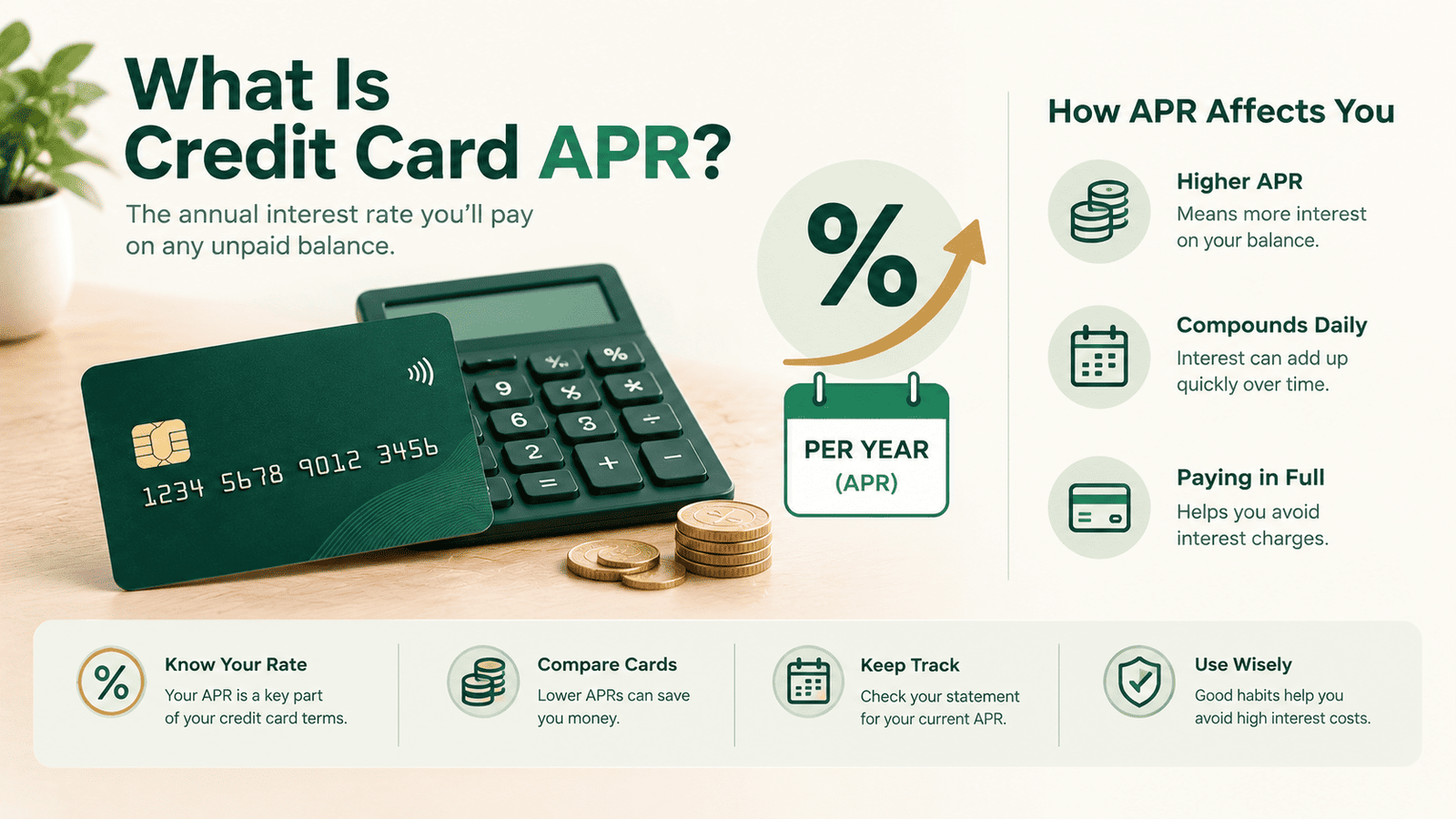
APR stands for Annual Percentage Rate. It expresses a credit card’s annualized borrowing rate. It does not mean that the issuer necessarily charges that percentage every month.
For example, a card with a purchase APR of 24% has an annualized rate of 24% for eligible purchase balances, subject to the agreement’s terms and interest calculation method.
A card may have different APRs for different types of transactions.
Common types of credit card APR
1. Purchase APR
This rate may apply to purchases when you carry a balance and do not qualify for an interest-free grace period.
2. Cash advance APR
Withdrawing cash through a credit card may involve a separate fee and a higher interest rate. Interest often begins accruing from the transaction date, so check your card agreement before using this feature.
3. Balance transfer APR
A balance transfer moves debt from one credit account to another. A promotional or standard APR may apply, and the issuer may charge a transfer fee.
4. Introductory APR
Some cards offer a low or 0% introductory APR for a limited period. Check when the offer expires, which balances qualify, and what rate applies afterward.
5. Penalty or increased APR
Certain missed payments or other events may lead to a higher rate under the card agreement and applicable law. Do not assume the rules are identical for every card.
For a useful explanation of common terms, see the Consumer Financial Protection Bureau’s credit card key terms guide.
How Is Credit Card Interest Calculated?
Credit card interest calculations depend on the issuer and your agreement. Many card issuers calculate interest daily, often using the daily periodic rate and the balance during the billing cycle.
The Consumer Financial Protection Bureau explains how credit card interest is calculated.
Here is a simplified example.
Suppose you have:
- Outstanding balance: $1,000
- Purchase APR: 24%
- Billing period: approximately one month
A rough estimate using a simple monthly-rate approximation is:
$1,000 × 24% ÷ 12 = $20
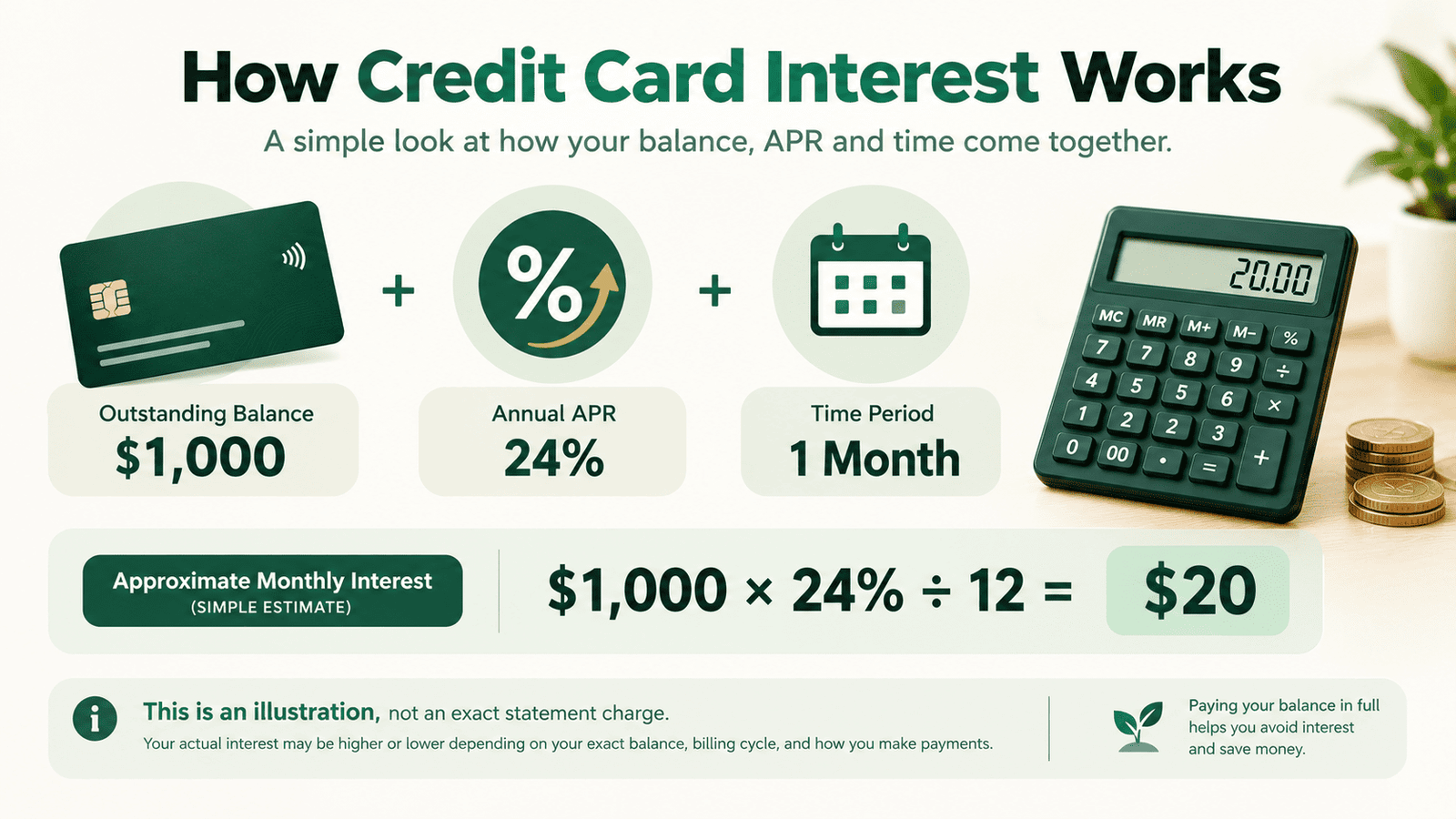
This suggests approximately $20 in interest for one month. However, it is only an illustration, not a prediction of your actual statement.
Your actual interest may differ because of daily balances, payments, new purchases, billing-cycle length, fees, and grace-period eligibility. Interest may also compound depending on the issuer’s calculation method.
Why paying earlier can matter
When interest is calculated using daily balances, reducing your balance earlier may reduce the amount on which interest accrues.
For example, paying part of your balance at the beginning of a billing cycle may help more than waiting until the end, depending on how your issuer calculates interest and credits payments.
Your statement and card agreement are the best places to confirm the calculation method that applies to you.
What Is an Interest-Free Grace Period?
A grace period is a period between the end of a billing cycle and the payment due date during which eligible purchases may avoid interest if you meet the card’s conditions.
Many cards offer a grace period on purchases, but issuers are not universally required to provide one. Cash advances generally have different rules.
If your card offers a grace period, paying the full statement balance by the due date may help you avoid interest on eligible purchases.
However, carrying a balance can affect your grace-period eligibility. Review the CFPB’s explanation of credit card grace periods for more detail.
Before relying on a grace period, check:
- Whether your card offers one.
- Which transactions qualify.
- Whether you must pay the full statement balance.
- What happens if you carry a balance from one billing cycle to the next.
Why Paying Only the Minimum Can Cost More
Your credit card statement usually shows a minimum payment. Paying at least that amount on time helps you meet the minimum payment requirement, but it may not reduce your debt quickly.
When you make only small payments, interest and fees can consume part of the money you pay. This leaves less to reduce the original balance.
Imagine owing $1,000 and making only small monthly payments while interest continues to accrue. Your balance may take a long time to clear, and the total amount you pay could be much greater than the original purchase.
To make progress:
- Pay more than the minimum whenever your budget allows.
- Avoid adding unnecessary purchases to a balance you are repaying.
- Set a realistic monthly debt-payment target.
- Make every required payment on time.
- Check whether your outstanding balance is actually falling.
If you need help organizing your spending before setting a repayment target, read our guide on how to build a monthly budget that actually works.
8 Practical Ways to Pay Less Credit Card Interest

1. Pay the full statement balance when possible
If you can afford it and your card offers a qualifying grace period, paying the full statement balance by the due date can help you avoid purchase interest.
Do not confuse the statement balance with the minimum payment. The minimum is generally the smallest required payment, not the amount needed to clear your bill.
2. Make payments on time
Late payments can lead to fees and other consequences. Depending on the card agreement and local rules, they may also affect your interest rate or credit history.
Set a reminder several days before your due date. If you use automatic payments, check that the linked account has enough money and that the payment amount matches your plan.
You can also read our guide to understanding your credit score to learn more about credit-related financial habits.
3. Pay earlier when it helps
If your issuer calculates interest using daily balances, an earlier payment may reduce the balance on which interest accrues.
Check when your payment will be credited and how your issuer calculates interest. The benefit depends on those details.
4. Avoid cash advances
Cash advances can be expensive because they may involve an upfront fee and interest from the transaction date.
Before withdrawing cash from a credit card, compare other options and check the total cost. Do not assume cash advances receive the same interest-free treatment as ordinary purchases.
5. Stop adding unnecessary debt
It is harder to repay a balance if new spending keeps replacing the money you have paid off.
While working on repayment, consider using money already set aside for routine expenses instead of adding new credit card purchases. Keep essential bills and necessary expenses in your budget.
6. Ask your issuer about a lower APR
Contact your card issuer and ask whether you qualify for a lower interest rate or a repayment option.
You could say:
“I am reviewing the cost of my credit card debt. Could you check whether I qualify for a lower APR or any repayment options?”
A reduction is not guaranteed. Confirm any new rate, fees, eligibility conditions, and duration before relying on an offer.
7. Compare balance transfer offers carefully
A balance transfer may reduce interest for some borrowers, particularly when a promotional rate is available. But transfer fees, promotional periods, eligibility rules, and the rate after the offer ends all matter.
Before transferring a balance, compare the likely interest savings with the fees. Make sure you can manage the payments before the promotional period expires.
Avoid building new debt on the original card after transferring a balance. Otherwise, you could end up managing debt on both accounts.
8. Choose a debt repayment strategy
If you have multiple debts, two common methods can help you organize repayments:
- Debt avalanche: Pay the minimum on every debt and direct extra money toward the debt with the highest interest rate. This can reduce total interest when other factors are similar.
- Debt snowball: Pay the minimum on every debt and direct extra money toward the smallest balance first. Clearing smaller balances may help some people stay motivated.
You can compare the two approaches in our guide to debt snowball vs. debt avalanche.
Whichever approach you choose, keep making the required payments on your other accounts. Choose a method you can realistically maintain.
Should You Close a Credit Card to Avoid Interest?
Not necessarily. Closing a credit card does not automatically eliminate an outstanding balance or stop interest from being charged under the existing agreement.
Before closing an account, consider whether you still owe money, whether recurring payments are linked to it, and whether closing it could affect credit utilization or credit history under your country’s credit-scoring system.
If a card encourages overspending, closing it may be worth considering. But do not assume that closing the account will erase your debt.
You can also contact the issuer to ask about lower-rate products or repayment arrangements, where available.
How to Read Your Credit Card Statement
Your statement can help you identify what you owe and understand the charges being applied.
Look for these items:
- Statement balance: The amount shown at the end of the billing period.
- Minimum payment: The minimum amount required under your agreement.
- Payment due date: The deadline for making the required payment.
- APR: The annualized borrowing rate applicable to a transaction category.
- Interest charged: Interest added during the billing period.
- Fees: Charges such as late-payment or cash-advance fees, if applicable.
- Transactions: Purchases, payments, refunds, and other account activity.
If a charge or interest amount appears incorrect, contact your issuer promptly and follow its dispute process. Keep copies of statements and relevant communications.
Common Credit Card Interest Mistakes to Avoid
Assuming the minimum payment clears the debt. It generally does not. Check how much of your payment reduces the outstanding balance.
Thinking APR is a monthly rate. APR is annualized; the issuer applies its stated calculation method.
Ignoring cash-advance costs. Cash advances may have separate fees, rates, and interest rules.
Missing the due date. Even a small unpaid amount can create problems if you miss the required payment deadline.
Accepting a promotional offer without reading the terms. Fees and the rate after the promotion can reduce or eliminate the savings.
Continuing to spend while repaying debt. New purchases can make it harder to bring down your balance.
Assuming every card works the same way. Rates, grace periods, fees, calculations, and consumer protections can vary by issuer and country.
Frequently Asked Questions
Is credit card interest charged every month?
Interest may be added during a billing cycle when you carry an interest-bearing balance or make transactions that accrue interest. The amount depends on your card’s terms and calculation method.
Does paying the minimum payment avoid interest?
Usually, no. Paying the minimum helps meet the required payment obligation, but interest may continue to accrue on the remaining balance.
Can I negotiate my credit card APR?
You can ask your issuer whether you qualify for a lower APR, but approval is not guaranteed. Your payment history and the issuer’s policies may affect the outcome.
Is a 0% introductory APR always a good deal?
Not necessarily. Compare the promotional period, fees, the rate after the offer expires, and your ability to repay the balance. Read the terms carefully before accepting.
Does paying early reduce interest?
It may help when interest is calculated using daily balances because an earlier payment can reduce the balance on which interest accrues. The benefit depends on when your payment is credited and your issuer’s calculation method.
What should I do if I cannot afford my credit card payment?
Contact your issuer as early as possible and ask about available hardship arrangements or repayment options. Prioritize essential living costs and understand the consequences of any arrangement before agreeing to it. A reputable nonprofit or regulated debt-advice service in your country may also be able to help.
Final Thoughts
Credit card interest becomes easier to manage when you understand your APR, know when your card charges interest, and have a repayment plan that fits your budget.
Whenever possible, pay the full statement balance by the due date. If you already carry debt, pay more than the minimum when you can, avoid unnecessary new borrowing, and compare lower-rate or balance-transfer offers carefully.
Most importantly, read your card agreement and statements rather than relying on assumptions. Small, consistent decisions can help reduce borrowing costs and give you more control over your money.
This article is for general educational purposes and is not personalized financial advice. Credit card terms, rates, and consumer protections vary by country and issuer. Check current terms before making financial decisions.
3 thoughts on “Credit Card Interest Explained: How APR Works and How to Pay Less”