
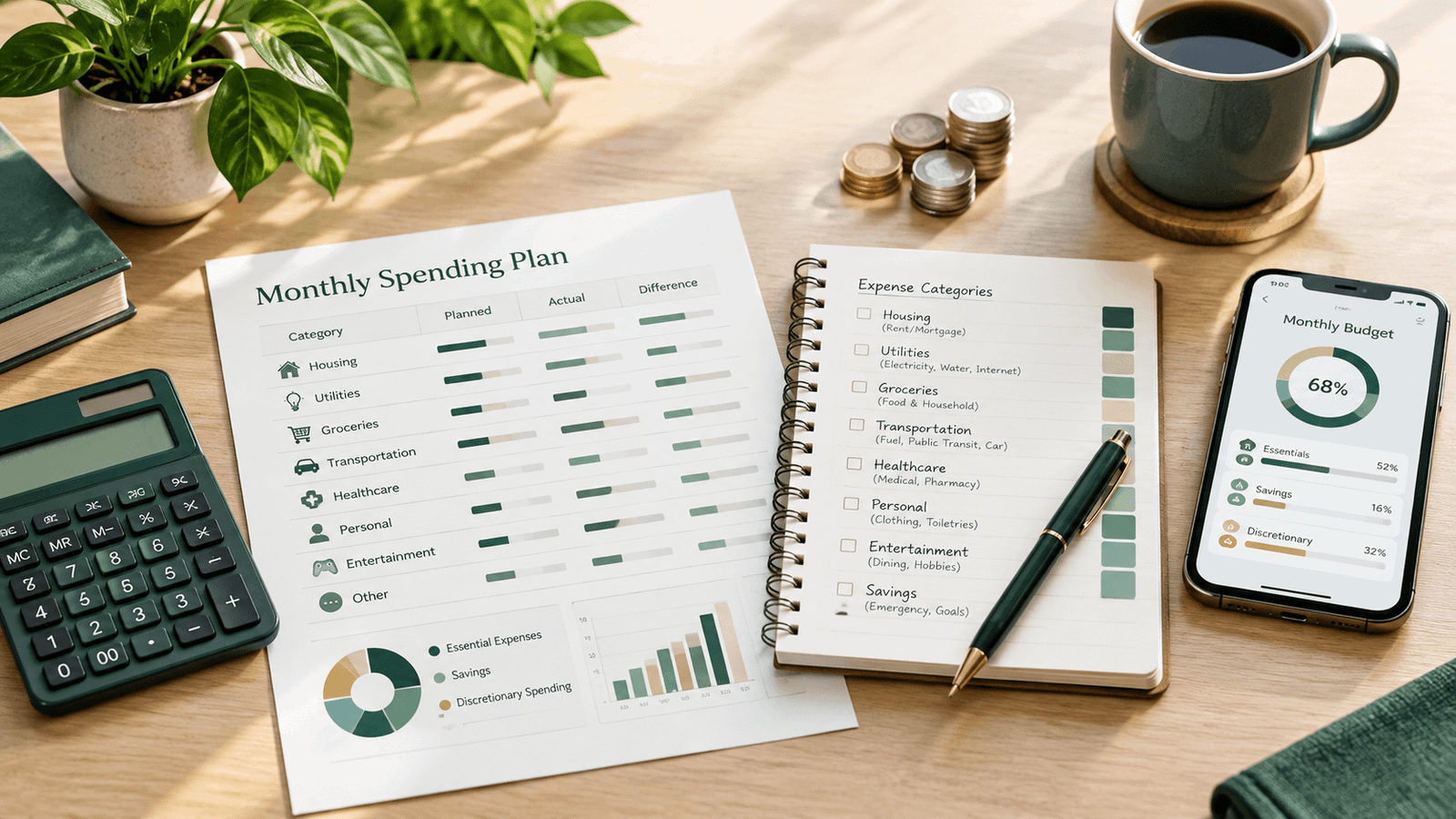
Managing money is not only about earning more or spending less. It is about knowing where your money goes, deciding what matters most, and making sure your everyday spending supports your priorities.
Many people try to control their spending by cutting out small purchases or promising themselves they will save whatever remains at the end of the month. Unfortunately, that approach can be difficult to maintain. Unexpected expenses appear, bills arrive, and money often disappears before savings goals receive attention.
A personal spending plan offers a more practical approach. It helps you decide in advance how to use your income for essential expenses, flexible spending, savings, and debt payments without making your life unnecessarily restrictive.
Unlike a complicated financial plan, a spending plan can be simple enough to manage with a notebook, spreadsheet, or budgeting app. You do not need a high income or perfect financial habits to begin.
In this guide, you will learn how to create a personal spending plan, choose a budgeting method, manage irregular income, handle unexpected expenses, and adjust your plan when real life does not go exactly as expected.
What Is a Personal Spending Plan?
A personal spending plan is a system for allocating your available income across different expenses and priorities. It helps you decide how much money to use for necessities, lifestyle spending, savings, and debt repayment.
A budget and a spending plan are closely related. A budget usually estimates income and expenses, while a spending plan emphasizes the decisions you make about using your money.
For example, imagine that your monthly take-home income is $3,000. You might allocate money to housing, groceries, transportation, utilities, insurance, savings, debt payments, and personal spending.
The exact amounts will depend on your situation. Someone living with family may have very different housing costs from someone renting an apartment. A self-employed person may also need a different approach from someone receiving a predictable monthly salary.
The purpose is not to copy another person’s budget. It is to create a system that reflects your own income, obligations, and priorities.
Why a Spending Plan Can Work Better Than Guessing
Without a clear plan, spending decisions often happen one purchase at a time. Each expense may appear affordable on its own, but together they can leave too little money for important bills or future needs.
A spending plan helps you see the bigger picture.
It makes your priorities visible
When essential bills, savings, and discretionary expenses have planned amounts, you can make more informed decisions about optional purchases.
It reduces financial surprises
Listing upcoming expenses helps you prepare for bills that occur weekly, monthly, annually, or only occasionally.
It helps prevent overspending
You can decide how much is available for eating out, entertainment, shopping, and other flexible categories before spending begins.
It makes saving more consistent
Instead of waiting to see what remains at the end of the month, you can include a realistic savings contribution in your plan.
It gives you room to adjust
A useful spending plan is flexible. If transportation costs increase or your income changes, you can revise the numbers rather than abandoning the entire system.
Step 1: Calculate Your Actual Take-Home Income
Start by identifying how much money you can realistically spend.
If you receive a salary, use the amount that reaches your bank account after deductions rather than your gross salary. If you are self-employed, freelance, or earn commissions, estimate your available income after setting aside money for taxes and necessary business costs where applicable.
Include reliable sources of income, such as:
- Salary or wages.
- Regular freelance payments.
- Consistent business income.
- Other dependable income sources.
Be cautious about including uncertain bonuses, occasional gifts, or hoped-for investment returns. A plan built on money you may not receive can create problems.
If your income changes every month, calculate a conservative baseline using your recent income history. Plan essential expenses around an amount you can reasonably expect, then decide how to allocate extra income when it arrives.
For example, if your monthly income has recently varied between $2,200 and $3,100, using the highest month as your regular spending limit may be risky. A more conservative baseline can help you avoid committing to expenses you cannot comfortably afford in a lower-income month.
Step 2: List Your Essential Expenses
Next, identify expenses you must cover to maintain your household, health, work, and basic responsibilities.
Common essential expenses include:
- Housing or rent.
- Electricity, water, and other utilities.
- Basic groceries.
- Necessary transportation.
- Insurance and healthcare.
- Phone or internet services needed for work or essential communication.
- Minimum required debt payments.
- Childcare or other essential family costs.
Review bank statements, receipts, and bills from the previous two or three months. Actual records are often more useful than trying to remember every expense.
Separate essential costs from optional spending where possible. For example, basic groceries are essential, while frequent restaurant meals may be flexible. A phone plan may be necessary, but a more expensive upgrade may not be.
Do not cut essential healthcare, safe housing, or necessary transportation simply to make a spreadsheet look better. If essential expenses already exceed your income, you may need broader changes, additional income, or support rather than unrealistic spending cuts.
Step 3: Find Your Flexible Spending Categories
Flexible spending includes costs that can often be adjusted without immediately affecting your basic needs.
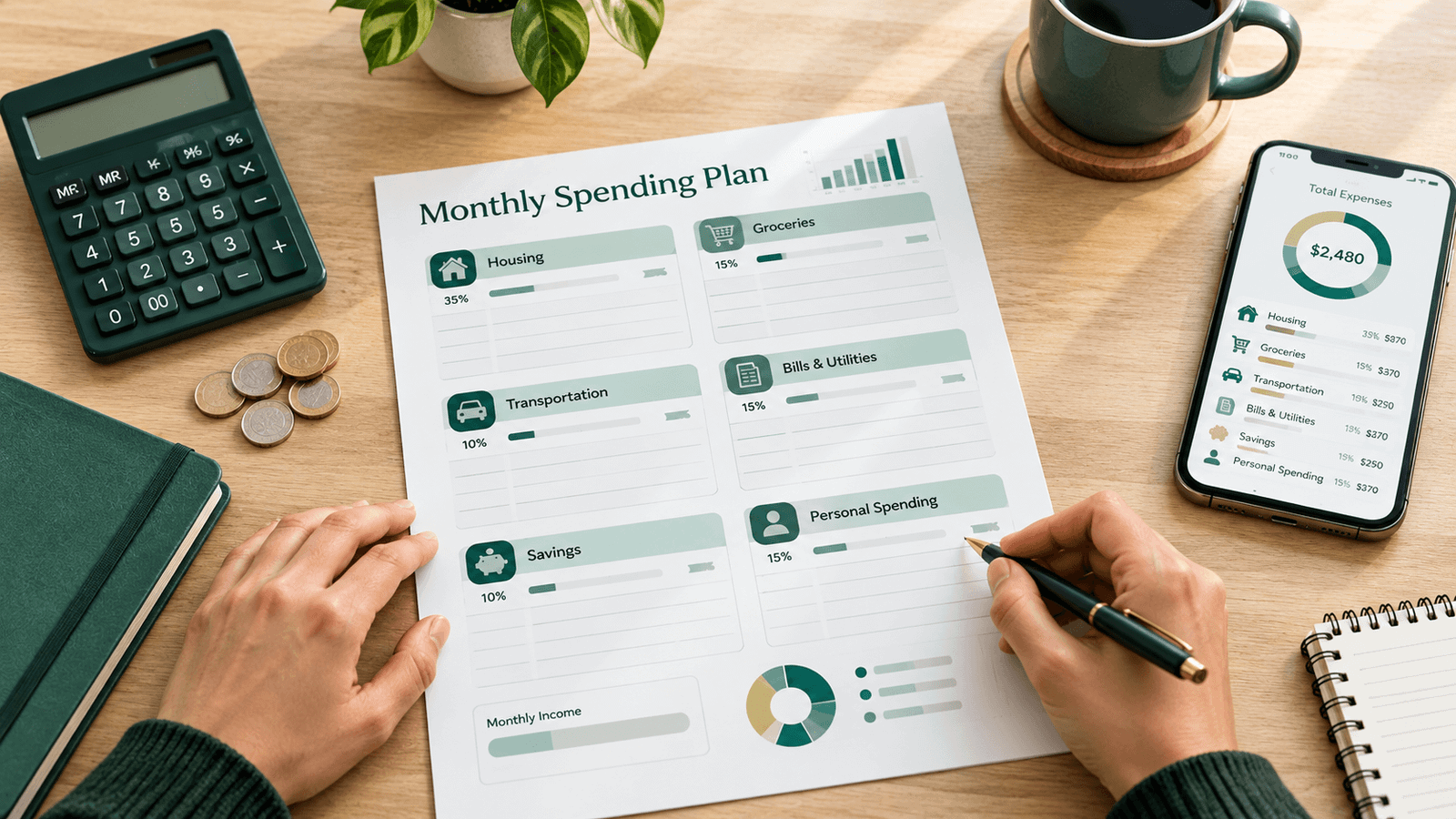
Examples include:
- Restaurants and takeaway meals.
- Entertainment and streaming subscriptions.
- Shopping and nonessential purchases.
- Hobbies.
- Travel and leisure.
- Gifts and celebrations.
- Convenience purchases.
Look at your recent spending and estimate how much you currently spend in each category.
Avoid judging every purchase as good or bad. The aim is to understand your habits and decide which expenses are worth keeping.
Suppose you discover that several small subscriptions and frequent takeaway orders add up to more than expected. You could reduce one category, cancel an unused subscription, or set a monthly limit while keeping the activities you value most.
You do not need to eliminate every enjoyable expense. A spending plan is more sustainable when it includes reasonable room for enjoyment.
Step 4: Choose a Spending Plan Method
Different methods suit different people. Choose one you can follow consistently rather than the one that sounds most sophisticated.
The 50/30/20 budgeting guideline
This popular guideline divides take-home income into three broad categories:
- 50% for needs.
- 30% for wants.
- 20% for savings and debt repayment.
For an illustrative monthly take-home income of $3,000, the guideline would suggest $1,500 for needs, $900 for wants, and $600 for savings and debt repayment.
These percentages are not universal rules. In an expensive city, essential costs may exceed 50%. Someone with high-interest debt or a low income may need a different allocation.
Use the guideline as a starting point, not a reason to feel that you have failed if your circumstances require different proportions.
Zero-based budgeting
With zero-based budgeting, you assign every dollar of your available income a purpose.
That does not mean spending all your money. Savings, emergency reserves, and additional debt payments can all receive allocations.
For example, if you have $3,000 available, your plan might allocate the full amount among bills, groceries, transportation, savings, debt payments, and flexible spending. The amount left unassigned at the end is zero.
This method can be useful if you want detailed control over where your money goes.
The pay-yourself-first method
With this approach, you set aside a realistic savings amount when income arrives, then plan your remaining spending around what is left.
It can work well if saving consistently is your main challenge. However, make sure essential bills and required payments remain covered.
The envelope or category-limit method
You set a spending limit for selected categories, such as groceries, eating out, or entertainment. You can track those limits using cash envelopes, separate account balances, or a digital tracker.
This method is especially useful if certain flexible categories regularly exceed your intended budget.
Which method should you choose? Start with the simplest approach that addresses your biggest problem. You can change methods later if your needs change.
Step 5: Give Every Major Expense a Realistic Amount
Once you have chosen a method, assign amounts to your categories.
Begin with fixed bills because they are usually easier to estimate. Then allocate money for variable essentials such as groceries and transportation, followed by savings, debt payments, and flexible spending.
Use recent spending records to guide your estimates.
For example, if you usually spend around $350 on groceries, setting a limit of $150 without a realistic reason may make your plan difficult to follow. You could begin with a smaller reduction and review the result after a month.
Also include a category for miscellaneous costs. Some expenses are difficult to predict, and a small buffer can make your plan more resilient.
If your total allocations exceed your available income, adjust the plan before the month begins. Look first at flexible spending, recurring costs you can reasonably reduce, and goals whose deadlines can be changed. Do not simply assume the difference will somehow disappear.
Step 6: Plan for Irregular Expenses
One of the most common reasons spending plans fail is that people account for monthly bills but forget about expenses that occur less frequently.
Examples include:
- Annual insurance premiums.
- Vehicle servicing and repairs.
- School supplies or education costs.
- Holiday and seasonal spending.
- Membership renewals.
- Home maintenance.
- Planned medical or dental expenses.
These costs may not be emergencies, but they can disrupt your finances if you ignore them.
Suppose you expect an annual bill of $600 in twelve months. Setting aside $50 per month can help you prepare for it.
The same approach works for many predictable expenses. Estimate the total cost, identify the deadline, and divide the amount by the number of months remaining.
You can keep these amounts in separate savings categories or track them in one account using a spreadsheet.

For more detail, see our guide to sinking funds for irregular expenses.
Step 7: Include Savings and Debt Payments
A spending plan should account for both your current obligations and your future financial stability.
If you do not have emergency savings, consider starting with a manageable amount. Even a modest reserve can help cover a smaller unexpected expense without automatically turning to borrowing.
Over time, you can work toward a larger reserve based on your essential expenses, income stability, dependants, and other circumstances.
If you have debt, include at least the required payments in your plan. After covering essential costs and required obligations, consider whether additional payments toward expensive debt should be a priority.
Avoid making extra debt payments so aggressively that you have no money for basic needs or foreseeable expenses. A balanced plan can help you make progress without repeatedly needing to borrow again.
If your main difficulty is building a safety net, our article on how to build an emergency fund explains how to get started.
Step 8: Decide When and How You Will Spend
A spending plan becomes easier to follow when it includes a practical routine.
Consider dividing your monthly allocations into weekly amounts for categories that are easy to overspend.
For example, a $400 monthly discretionary spending limit could be divided into roughly $100 per week. This is only a tracking method; the appropriate amount depends on your budget and the timing of your expenses.
You can also align spending decisions with your pay schedule. If you receive income twice a month, decide which bills and savings transfers should be covered by each payment.
Before making a nonessential purchase, check the remaining amount in the relevant category. If the money is already committed to a necessary expense, postpone the purchase or adjust another flexible category deliberately.
This does not mean every purchase needs a lengthy calculation. The purpose is to create a simple habit of checking whether a purchase fits your plan.
Step 9: Make Your Spending Plan Easy to Maintain
A complicated system may work for a week and then become too time-consuming.
Choose a tracking method that fits your habits:
- A simple spreadsheet.
- A notebook.
- A budgeting app.
- Your bank’s transaction categories.
- A combination of account balances and a monthly checklist.
Track only the detail you need. Some people benefit from recording every transaction, while others can manage with category totals and regular bank-statement reviews.
If you share household expenses with a partner or family member, agree on how you will track joint bills and contributions. Clear communication can prevent confusion about which expenses have already been paid.
For recurring bills, reminders or automatic payments may help, provided your account has enough money and the payment details are correct.
The best system is one you can use repeatedly without making money management feel like a second job.
Step 10: Review and Adjust Your Plan
Your first spending plan is an estimate, not a permanent contract.
At the end of each month, compare planned amounts with actual spending. Identify which categories were accurate, which exceeded expectations, and which had money left over.
Ask yourself:
- Did I cover all essential expenses?
- Did I make the savings and debt payments I planned?
- Which categories exceeded their limits?
- Were there unexpected costs or forgotten bills?
- What one change would make next month easier?
If grocery costs were higher than expected, revise the estimate or examine whether some purchases can be adjusted. If you consistently spend less on transport, you may be able to reallocate the difference.
When income falls, protect essential expenses first and adjust flexible allocations. When income increases, decide deliberately how much should go toward savings, debt, and lifestyle spending instead of automatically increasing every expense.
A spending plan should change when your life changes. Regular adjustments are a sign that the system is working, not proof that it has failed.
A Practical Monthly Spending Plan Example
Consider a hypothetical person with $3,000 in monthly take-home income. The following example shows one way to organize the money.
| Category | Monthly amount |
|---|---|
| Housing and utilities | $1,050 |
| Groceries and household supplies | $350 |
| Transportation | $200 |
| Insurance and healthcare | $150 |
| Minimum debt payments | $150 |
| Emergency and other savings | $400 |
| Irregular-expense fund | $150 |
| Restaurants and entertainment | $250 |
| Personal and miscellaneous spending | $150 |
| Buffer for changing expenses | $150 |
| Total allocated | $3,000 |
These numbers are illustrative, not recommended percentages for everyone. Actual costs differ by location, household size, debt obligations, and lifestyle.
Notice that the example includes money for savings, irregular expenses, and a buffer instead of allocating every dollar to routine monthly bills.
If your essential expenses take up a larger share of income, your plan may look very different. Start with your actual numbers and adjust what is realistic.
What to Do When Your Spending Plan Does Not Work
Sometimes the problem is not a lack of discipline. Your income may be insufficient for your essential costs, your estimates may be inaccurate, or an unexpected event may have changed your situation.
If your plan repeatedly fails, identify the underlying reason.
If essential expenses exceed income: Review whether any costs can safely be reduced, explore available assistance, and consider realistic income options. Avoid cutting necessary food, healthcare, or safe housing to force the numbers to work.
If flexible spending keeps exceeding limits: Try more specific category limits, remove unused subscriptions, or create a waiting period for larger nonessential purchases.
If unexpected expenses disrupt the plan: Increase your buffer where possible and set aside money for predictable irregular costs.
If income changes every month: Use a conservative baseline and allocate additional income only after essential needs and immediate obligations are covered.
If debt payments consume most of your income: Contact creditors early if you are struggling, ask about available repayment options, and seek reputable local debt guidance where appropriate.
A spending plan cannot solve every financial problem on its own. However, it can reveal what is happening and help you choose the next practical step.
Common Spending Plan Mistakes to Avoid
Making the plan too restrictive
A plan that removes every enjoyable expense can be difficult to maintain. Allow reasonable spending for activities that matter to you.
Forgetting annual and irregular bills
These expenses are easy to overlook because they do not appear every month. Estimate them and spread the cost over time when possible.
Using gross income instead of take-home income
Your available spending money is generally lower than your gross salary after taxes and other deductions.
Setting arbitrary spending limits
Use actual records to create realistic starting amounts. You can reduce spending gradually where appropriate.
Treating savings as whatever remains
If saving is important and your essential obligations are covered, include a realistic contribution in the plan rather than relying entirely on leftovers.
Ignoring small recurring charges
Subscriptions and recurring fees can add up. Review them periodically and cancel services you no longer use.
Never reviewing the numbers
Your expenses and income change. Check the plan regularly and make reasonable updates.
Frequently Asked Questions
Is a spending plan different from a budget?
They are closely related. A budget estimates income and expenses, while a spending plan emphasizes how you intentionally allocate available money to bills, savings, debt, and flexible spending. Many people use the terms interchangeably.
How much of my income should I save?
There is no single percentage that works for everyone. The right amount depends on your income, essential costs, debt, dependants, and goals. Start with an amount you can sustain and increase it when your circumstances allow.
What if I have no money left after paying bills?
First, review your actual income and essential expenses. Check for costs that can safely be reduced, look for available assistance, and consider realistic ways to improve income. If required expenses consistently exceed income, an extremely restrictive budget will not solve the underlying shortfall.
Should I use cash or a budgeting app?
Either can work. Cash or envelope methods can make category limits more visible, while apps and spreadsheets can simplify tracking and calculations. Choose a method you can use consistently and that protects your financial information.
How often should I review my spending plan?
A brief weekly check can help with flexible spending, while a fuller monthly review lets you compare planned amounts with actual expenses. Review sooner if your income or circumstances change significantly.
Can a spending plan help me pay off debt?
Yes. It can help you identify available money for additional payments after essential costs and required payments are covered. Choose a repayment strategy that fits your circumstances and avoid taking on new debt unnecessarily.
What should I do with money left over at the end of the month?
Decide in advance how surplus money will be used. Depending on your situation, you might add to emergency savings, pay down expensive debt, fund an upcoming expense, or contribute toward a longer-term goal.
Final Thoughts
A personal spending plan helps you make deliberate decisions about your money instead of hoping everything works out at the end of the month.
Start by calculating your take-home income, listing essential expenses, identifying flexible spending, and choosing a method you can maintain. Include savings, debt payments, irregular costs, and a reasonable buffer so your plan reflects real life.
You do not need perfect numbers on the first attempt. Review your actual spending, learn from the differences, and make practical adjustments every month.
The aim is not to control every penny forever. It is to give your money a clear purpose while leaving enough flexibility to handle everyday life.
Disclaimer: This article is for general educational purposes only and is not personalized financial, tax, investment, or legal advice. Financial products, regulations, and consumer protections vary by country. Review relevant terms and seek qualified advice when needed.
3 thoughts on “How to Create a Personal Spending Plan That Actually Works”